
Introduction
A missing signature. A skipped weather note. A crew headcount nobody wrote down. These small gaps in jobsite paperwork have a way of becoming very expensive problems later.
Payment disputes and delay claims live and die on documentation. When they land, the numbers get big fast. The average North American construction dispute was valued at $43.0 million in 2023, with resolution taking an average of 14.4 months, according to Arcadis's 2024 Construction Disputes Report.
A daily construction log is one of the cheapest insurance policies a contractor can carry. It's a written record, kept every day, that protects your business, keeps crews accountable, and keeps clients in the loop.
This guide covers what belongs in a daily log, a free template you can start using today, and how to decide between digital and printed forms for your crews.
Key Takeaways
- Daily logs create a contemporaneous paper trail supporting payment claims and delay disputes.
- A complete log covers project info, weather, labor, equipment, materials, safety, and sign-off.
- Digital apps suit large, multi-site GCs, while printed forms remain essential without reliable connectivity.
- Consistency matters more than format: daily gaps significantly reduce a log's evidentiary value.
What Is a Daily Construction Log?
A daily construction report is a written, photographic, or electronic record documenting exactly what happened on a jobsite in a single day, according to Construction Executive. That includes labor, materials, weather, safety conditions, and progress against schedule.
Who typically completes it:
- Superintendents or foremen (most common)
- Project managers, who often review and sign off
- Field managers on larger crews with dedicated documentation staff
Who relies on it:
- Owners and general contractors tracking progress
- Subcontractors protecting their own labor and material claims
- Inspectors verifying compliance
- Insurers and attorneys during disputes or claims
Daily logs aren't standalone paperwork. They roll up into weekly and monthly progress reports, and they become the backbone of larger project documentation. When a dispute lands months or years later, these entries are often the only contemporaneous evidence of what actually happened on a given day.
Why Consistency Is the Whole Point
A log with three-day gaps is far less useful than one filled out religiously, even briefly. Reports written while work is happening, or immediately after, provide the most accurate account, per Construction Executive's reporting guidance.
Backfilled entries from memory the next morning tend to blur details that matter most: exact delay causes, specific delivery times, who exactly was on-site.
That daily discipline is what separates a log that holds up under scrutiny from one that gets dismissed as an afterthought.
What Should Be in a Daily Construction Log? (Complete Checklist)
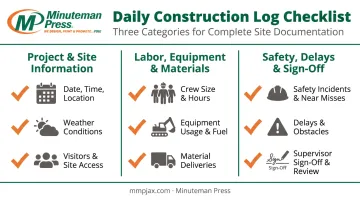
A thorough log has three core groups. Miss one, and you've created a blind spot that surfaces at the worst possible time.
Project & Site Information
- Project name, location, date, and report number: for filing and quick reference
- Preparer's name and signature: establishes who's accountable for the entry
- Weather conditions: temperature, precipitation, and wind, which directly affect schedule and delay liability
- Site visitors: inspectors, owners, and consultants, logged for security and compliance purposes
Labor, Equipment & Materials
- Crew headcounts and subcontractors present: hours worked, tied to payroll and productivity tracking
- Equipment on-site: hours used, plus any downtime or malfunctions
- Material deliveries: quantities received, quantities used, shortages, or damaged goods
Subcontractors should tie labor hours to specific work items in their own logs, a practice Cohen Seglias construction attorneys recommend for defending against inefficiency claims later.
Safety, Delays & Sign-Off
- Safety incidents and near-misses: including PPE compliance notes and references to any formal incident reports filed separately
- Delays or disruptions: weather, missed deliveries, access issues, written in objective, factual language rather than opinion
- Closing summary: progress notes, photos or attachments, and a supervisor's signature confirming accuracy
Delays and inefficiencies should be repeated in the report for every day they continue, not just the first day they appear. That running record is often what proves duration in a delay claim.
Free Daily Construction Log Template You Can Use Today
A standardized, fillable template does one job well: it makes sure nobody skips a critical field because they were rushing at 4:45 PM.
Whether it lives on a tablet or a clipboard, a good template should:
- Preload standard project details, including name, address, contract number, and preparer role, so crews aren't retyping the basics every day.
- Update in real time: entries get logged throughout the shift, not reconstructed from memory afterward.
- Require review and sign-off before filing so a second set of eyes catches gaps while they're still fixable.
Templates aren't one-size-fits-all, either. A daily log built for a general contractor can be adapted for specific trades by adding a few checklist items:
- Electrical crews: panel schedules, circuit testing, inspection sign-offs
- Roofing crews: substrate conditions, membrane lot numbers, wind speed thresholds
- Plumbing crews: pressure test results, fixture counts, rough-in inspections
Start with the core categories above, then layer in what's specific to your trade. Once your version is finalized, Minuteman Press can print it as a durable, field-ready form for every crew on site.
Digital vs. Printed Daily Logs: Which Should You Use?
There's no universal answer here — it depends on your jobsites, your crews, and your contracts.
The Case for Digital
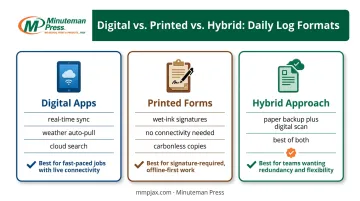
Mobile daily reporting apps offer real-time syncing, automatic weather pull-ins, and searchable cloud archives. That's especially useful for general contractors managing multiple sites at once. It's not a niche practice, either: 71% of construction firms already use mobile devices in the field to create project documentation, according to JBKnowledge's Construction Technology Report.
But apps have real limitations in the field:
- Dead zones on remote or rural sites
- Dead batteries by mid-afternoon
- Muddy or wet touchscreens that won't register input
- Crews who simply aren't comfortable with the software
The Case for Printed Forms
Printed logs remain essential in specific scenarios:
- Government or bonded contracts that require wet-ink signatures
- Quick handoffs between office, field, and client using carbonless (NCR) forms
- Jobsites with no reliable connectivity, where relying on an app can cost more time than it saves
The Hybrid Approach
Many contractors land on a middle ground: complete printed logs in the field, then scan or photograph them into digital storage for backup and easy sharing. Even companies fully committed to reporting software should keep a supply of durable, pre-printed backup logs on hand. Outages and dead equipment don't check your project schedule first, and having custom carbonless log forms on hand, like those Minuteman Press prints locally, gives crews an instant paper backup ready before signal loss strikes.
Best Practices for Filling Out Daily Logs
Format matters less than what you actually write. A few habits separate logs that hold up from ones that don't:
- Stick to objective facts. "Delivery arrived four hours late" holds up in a dispute; "subcontractor was careless" doesn't.
- Attach photos whenever possible. Date- and location-tagged photos establish timelines that notes alone can't, and missing them can weaken your position in a dispute.
- Set a fixed daily deadline. Complete entries before crews leave site, not the next morning — memory loses precision on causes and timing.
A contemporaneous daily report, backed by photos and consistent terminology, is far more persuasive than a reconstructed account written days later.
Get Custom, Durable Construction Forms Printed by Minuteman Press
Plenty of contractors still prefer physical logs for the jobsite, and there's a good reason: paper doesn't lose signal, doesn't run out of battery, and doesn't need a software update mid-pour.
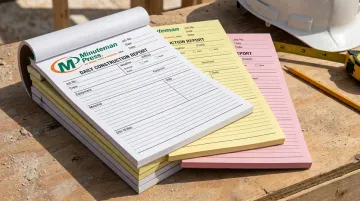
Minuteman Press in Jacksonville produces custom carbonless (NCR) daily report pads, giving you office, field, and client copies in a single write. That means your foreman fills out one form and everyone who needs a copy gets one instantly, no scanning required.
What you can typically customize:
- Durable, weather-resistant paper stock built to handle dusty, wet, or high-traffic jobsite conditions
- Custom branding with your company logo and colors, which reads as more professional when a client, inspector, or owner sees it
- Form layout tailored to your trade and reporting needs, not a generic template
The team offers quick turnaround and hands-on consultation to help you design a form that actually matches how your crews work. If you're ready to move away from smudged handoffs and missing paperwork, reach out to the Minuteman Press team or request an estimate to talk through your form specs.
Frequently Asked Questions
What should be in a construction daily report?
A complete report covers project and site info, weather conditions, crew and labor hours, equipment used, material deliveries, safety incidents, delays, and a final sign-off. See the full checklist above for details on each category.
How long should construction daily logs be kept?
Retention often ties to your state's statute of repose, which ranges from 4 to 15 years depending on location, according to Saxe Doernberger & Vita. Check your specific contract terms and state requirements to set a retention policy.
Who is responsible for filling out the daily log?
Superintendents or foremen usually complete the daily entry, with a project manager reviewing and signing off. Some firms assign a second reviewer specifically to check for completeness before filing.
Can I use a printed template instead of a mobile app?
Yes. Printed templates are a solid choice for contracts requiring wet-ink signatures or job sites without reliable connectivity. Minuteman Press and similar local print shops can produce durable log books for crews who prefer paper records, then pair them with photo backups for the strongest documentation.
What's the difference between a daily report and a daily log?
The terms are largely interchangeable in everyday use. Some contractors use "log" for a running, informal record and "report" for the formatted document shared with owners or GCs.
Do subcontractors need to keep their own daily logs?
Yes. Subcontractors should maintain independent logs tying labor hours to specific work items, in addition to contributing to the master daily report. This protects them if a dispute arises with the general contractor.