Pronoun inclusion often gets filed under "DEI initiative" and left there. But its actual payoff shows up somewhere much more mundane: the handshake, the intro at a trade show booth, the follow-up email where you're not sure if you should write "he" or "she." This article breaks down why pronoun visibility on business cards matters in daily practice, not just policy documents, and how to roll it out without making it feel like an afterthought.
Key Takeaways
- Pronouns on business cards prevent misgendering right from the first introduction
- This visibility signals inclusion to employees, clients, and job candidates alike
- Clear pronoun labeling removes guesswork tied to unisex or unfamiliar names
- Skipping or inconsistently applying pronouns creates mixed signals and friction
What Are Pronouns on Business Cards?
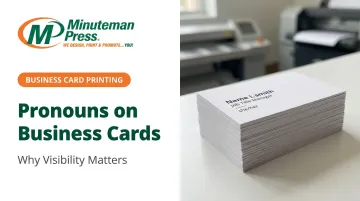
Adding pronouns to a business card means printing a short line, typically she/her, he/him, or they/them, directly beneath a person's name or job title. That's it. No redesign required, no extra panel needed.
This shows up most in:
- Client-facing roles where first meetings happen constantly
- Conferences and networking events where names get exchanged fast
- Healthcare, education, legal, and corporate settings with diverse teams and formal introductions
These fields stay optional, not required. They aren't a mandate, and they're not a trend businesses need to chase for optics. Most companies treat it as an opt-in field — something an employee can choose to include, not something forced onto every card in the print run.
Key Advantages of Adding Pronouns to Business Cards
The advantages below aren't abstract. They tie directly to things businesses already measure: retention, client relationships, and brand perception. If you're evaluating whether this is worth adding to your next print order, these are the outcomes that actually move the needle.
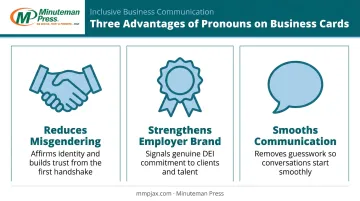
Reduces Misgendering and Builds Psychological Safety
Stating pronouns upfront removes the guesswork. A colleague or client meeting someone for the first time doesn't have to guess, and the cardholder doesn't have to correct anyone mid-conversation. That small shift normalizes the topic without forcing anyone to explain themselves repeatedly.
The stakes here are real. A peer-reviewed analysis of the 2020 Australian Workplace Equality Index, covering more than 25,000 employees across 149 organizations, found that 51% of binary transgender respondents and 26% of nonbinary transgender respondents had been mispronouned repeatedly and on purpose at work. That's a documented pattern with real workplace consequences.
Separate qualitative research on nonbinary employees suggests a link between repeated misgendering and burnout across three dimensions: emotional exhaustion, detachment, and reduced effectiveness at work. Employees describe the constant correcting as distracting and draining, sometimes leading them to withdraw from coworkers or consider leaving altogether.
KPIs this affects:
- Employee engagement scores
- Inclusion survey results
- Retention among diverse staff
Client-facing roles and formal industries like healthcare, education, and legal services feel this most, since first impressions happen constantly and mid-meeting corrections put everyone on edge.
Strengthens Employer Brand and DEI Credibility
A business card is one of the few external touchpoints that leaves the building. Every card handed out either reinforces or undermines whatever inclusion values a company claims to hold. A visible, well-formatted pronoun option signals that a company actually thought through its policy rather than just posting a statement somewhere on its website.
This matters more with younger talent. Deloitte's 2024 Gen Z and Millennial Survey, which polled nearly 23,000 respondents across 44 countries, found that 44% of Gen Z respondents and 40% of millennials had rejected an employer based on personal ethics or beliefs, with non-inclusive practices explicitly named as one of the driving reasons.
KPIs this affects:
- Talent acquisition rate
- Employer brand perception
- Client retention among diversity-conscious buyers
Recruiting events and first client meetings put this on display most, especially for companies competing over the same shrinking pool of younger, diversity-minded talent.
Smooths Communication and Reduces Interaction Friction
Pronouns resolve a practical problem: names don't always signal gender clearly. Unisex names, cross-cultural names, or simply unfamiliar spellings leave people guessing during introductions, follow-up emails, and event announcements.
That ambiguity is exactly why the Human Rights Campaign Foundation specifically recommends giving employees the option to display pronouns on physical name badges and business cards. Accidental misgendering can embarrass both parties and create tension that lingers well past the initial exchange.
KPIs this affects:
- Communication accuracy
- Networking conversion rate
- Client relationship quality
Cross-cultural business dealings, large conferences, first meetings with unfamiliar colleagues, and quick email introductions all surface this friction, since visual or verbal cues alone can't be trusted.
What Happens When Pronoun Visibility Is Ignored
Skipping pronouns entirely isn't neutral. It creates its own set of problems, some immediate and some that compound over time.
Common consequences include:
- Inconsistent signals when only a few employees add pronouns, leaving clients and coworkers unsure what the company's actual policy is
- Repeated misgendering that leads to employee fatigue and disengagement over time
- Missed differentiation as an inclusive employer or vendor in a market where competitors are already doing this
- Falling behind industry norms as more companies adopt inclusive stationery as standard practice
- Scaling problems when there's no clear guideline, making it harder to roll out consistently across departments or locations later
None of this requires a dramatic policy failure. It just requires doing nothing, which is often exactly what happens when pronoun inclusion gets treated as a "someday" project instead of part of a standard print refresh.
How to Get the Most Value from Pronoun Inclusion on Business Cards
Pronoun visibility works best when it's optional, consistently formatted, and part of a broader communication standard, not a one-off design tweak.
A few practical guidelines:
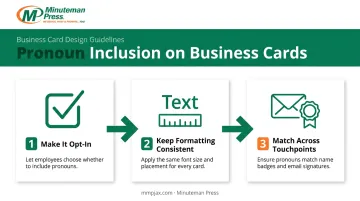
- Make it opt-in. Let employees choose whether to include pronouns. Forced disclosure defeats the purpose and can feel invasive.
- Keep formatting consistent. Same placement, same font size, same style across every card. Consistency is what makes it look intentional rather than bolted on.
- Match it across touchpoints. Pair business card pronouns with matching email signatures and name tags so the signal is unified, not scattered.
These guidelines are straightforward on a single card. Scaling them across dozens or hundreds of employees, especially with staff turnover and title changes, is where a print partner outperforms a DIY template.
Minuteman Press in Jacksonville keeps pronoun placement clean and consistent across a whole team's cards. When someone's title, name, or pronoun field changes, reprints turn around fast.
Conclusion
Pronoun visibility on a business card is a small design change with an outsized payoff. It reduces misgendering before it happens, reinforces whatever inclusion values a company holds, and removes a layer of friction from everyday introductions.
The value compounds the longer a consistent policy stays in place. One clear standard, applied the same way across every card, prevents the confusion and fatigue that come from doing it halfway. Treat pronoun inclusion as an ongoing part of how your company communicates, not a box checked on one print order. Minuteman Press in Jacksonville can help build that standard into your next business card order, from design through final print.
Frequently Asked Questions
Should you include pronouns on business cards?
It's a personal and organizational choice. Most companies treat it as an opt-in field, letting individual employees decide, which supports inclusion without making it mandatory for anyone.
What not to put on a business card?
Avoid excessive personal details, outdated contact info, cluttered layouts, or unnecessary logos and affiliations. A clean card with essential information always outperforms a crowded one.
What pronouns do you use for a business?
Businesses don't use personal pronouns themselves. Individual employees can list their own, such as he/him, she/her, or they/them, on their personal cards.
Is it unprofessional to put pronouns on a business card?
No. Pronoun inclusion is becoming standard professional practice across many industries. It reflects modern workplace norms rather than signaling anything unprofessional.
How do you format pronouns on a business card?
Place pronouns directly under the person's name or job title, using a small, consistent font that matches the rest of the card's design.
Do all employees need to include pronouns?
No. Inclusion should be optional and employee-driven. Companies offer the choice; they shouldn't require it company-wide.
Visit Us in Jacksonville
Minuteman Press Jacksonville prints business cards with clean, consistent pronoun placement across a whole team's order - and turns around reprints fast when names, titles, or pronoun fields change. Call 904-733-5578 or visit 4185 Sunbeam Road, Suite 100, Jacksonville, Florida 32257 to discuss your next business card order.