The trouble is, many roofers waste that advantage. Generic postcards with no targeting strategy, weak offers, or cluttered layouts get tossed straight into the recycling bin, burning through print and postage budgets with nothing to show for it.
This guide breaks down why postcards still work for roofing lead generation, what to put on them, how to find the right homes to mail, which formats perform best, and how to launch a campaign that actually gets tracked and measured.
Key Takeaways
- Physical mail builds trust digital ads can't match—especially for high-cost roofing decisions
- Even a modest response rate can deliver strong ROI given the size of an average roofing job
- Precise targeting (storm history, home age, property data) matters more than mailing volume
- Sturdy, image-heavy postcards outperform flimsy, text-dense formats
- Tracking mechanisms are non-negotiable if you want to measure what actually works
Why Direct Mail Postcards Still Deliver Results for Roofing Companies
The Trust & Physical Advantage Over Digital Ads
Postcards can't be muted, blocked, or scrolled past. A homeowner has to pick it up and decide whether to toss it or read it. That brief physical interaction is something no banner ad can force.
Trust plays into this too. According to MarketingSherpa's consumer research, somewhere between 70% and 83% of consumers (depending on generation) say they trust ads or catalogs they receive by mail when making purchase decisions. That's a meaningful edge for a business asking someone to spend thousands of dollars on their roof.
Repetition matters too. Marketers often reference the "Rule of Seven," the idea that a prospect needs multiple exposures to a brand before they act. It's more of a working heuristic than a proven law, but it maps naturally onto how roofing postcards get used in practice:
- First mailing introduces your company to the neighborhood
- Second mailing (weeks later) reinforces the message with a different angle
- Third mailing adds urgency, a deadline, or a seasonal offer
Roofing is a big-ticket, low-frequency purchase. Homeowners don't buy on the first touch. A sequenced mailing to the same streets builds the familiarity that eventually turns into a phone call.
The ROI Advantage for Home Service Businesses
Direct mail's return-on-investment case for home services comes down to straightforward math. According to ANA's Response Rate Report, house-list postcards generated 92% ROI, while prospect-list oversized and dimensional mail pieces topped 90% as well. These are general direct mail figures, not roofing-specific, but they show postcards holding their own against pricier formats.
Here's why that matters for roofing specifically: the average roof replacement or major repair runs into the thousands of dollars. That changes the math on response rate entirely.
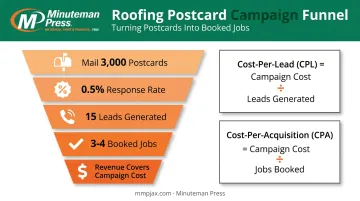
- If you mail 3,000 postcards and only 0.5% respond, that's 15 leads
- If even 3-4 of those leads convert to booked jobs, a single roof replacement can cover the entire campaign cost
Cost-per-lead is your total campaign spend divided by number of responses. Cost-per-acquisition is that same spend divided by actual booked jobs. Track both, because a cheap lead that never converts isn't actually cheap.
Postcard stock is another lever. Heavier, laminated, or oversized cards tend to feel more substantial in the hand than flimsy standard paper. There's no controlled study proving a specific response lift from upgraded stock, but it's a low-cost test worth running against your current baseline.
What to Include on a High-Converting Roofing Postcard
Headline & Irresistible Offer
Your headline has about two seconds to earn a second glance. Tie it to something the homeowner already cares about, not a generic company slogan.
A few headline formulas that work well for roofing:
- Storm-triggered: "Storm Damage in [Neighborhood]? Get a Free Roof Inspection This Week"
- Financing-focused: "New Roof, $0 Down: Financing Available for [City] Homeowners"
- Urgency-based: "Roof Showing Its Age? Free Inspection Ends [Date]"
Pair the headline with a clear, time-bound offer. "Free inspection" alone doesn't create urgency; "Free inspection through the end of the month" does. Discounts, limited-time financing terms, or a seasonal deadline all push a homeowner from "I'll call eventually" to "I should call now."
Visual Proof & Before/After Storytelling
Text tells people you're good. Photos show them. A well-lit before-and-after shot of a completed roofing job does more convincing in three seconds than a paragraph of copy does in thirty.
- Use natural lighting and shoot from an angle that shows the full scope of the work.
- Avoid stock photos. Homeowners can usually tell.
- If you don't have strong job-site photography yet, start documenting every job going forward.
Strong photos work even harder next to a QR code that bridges the postcard and your digital presence. Link one to a photo gallery, a page of Google reviews, or an instant quote form. It gives the homeowner a next step that doesn't require a phone call if they're not ready for one yet.
Trust Signals & Clear Contact Info
Roofing is a safety-related, high-cost purchase. Homeowners are naturally cautious about who they let onto their roof and into their finances. Trust signals aren't optional decoration—they're what gets the postcard taken seriously.
Must-have trust elements include:
- License and insurance information, clearly stated
- BBB rating or accreditation badge, if applicable
- Warranty details, even a brief mention
- Review count or star rating from Google or a similar platform
Contact information needs to be large, legible, and impossible to miss: phone number, website, and a physical address if you have one.
A professionally laid-out piece signals credibility before anyone reads a word of copy. This is where working with a full-service printer that offers design support, like Minuteman Press, pays off. Getting the layout print-ready and polished the first time avoids the delays that come with amateur file errors.
Targeting the Right Homeowners for Maximum ROI
Data-Driven Neighborhood Selection
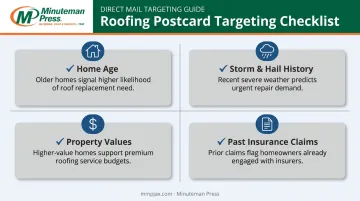
Not every neighborhood is worth mailing to. Before committing budget, look at:
- Home age — older roofs are more likely to need attention soon
- Storm and hail history — areas with recent severe weather events are prime candidates
- Property values — helps calibrate your offer and messaging tone
- Past insurance claim trends — clusters of prior claims signal higher near-term demand
Pair that data with a quick visual "windshield survey." Drive the target streets and look at visible roof wear, moss, curling shingles, patch jobs. It's low-tech, but it sharpens your list faster than data alone.
Storm-Triggered & Seasonal Campaigns
Speed matters after a storm. When hail or high winds hit a specific zip code, homeowners start noticing damage (or get told about it by neighbors) within days. Roofers who hit that window first capture a disproportionate share of the leads.
- Monitor storm activity through resources like NOAA's Storm Events Database to identify affected areas quickly
- Have a pre-approved postcard design and messaging template ready to go, so you're not designing from scratch after the storm hits
- Prioritize the affected zip codes first, then expand to adjacent areas
Seasonal windows matter too. Spring and early fall are peak roofing seasons in most U.S. markets—homeowners plan replacements before summer heat and winter weather. Time drops to land 2–3 weeks before those busy periods so your offer is in hand when they start calling contractors.
Building & Sourcing Your Mailing List
Choose your list method based on precision versus cost:
| Method | Precision | Cost | Best For |
|---|---|---|---|
| EDDM (no list needed) | Low | Lower | Broad neighborhood saturation |
| Targeted property-data list | High | Higher | Storm zones, older homes, specific criteria |
| Generic "Current Resident" | Low | Moderate | Quick, low-effort campaigns |
Every Door Direct Mail through USPS covers every address on a selected carrier route with simplified addressing—no purchased list required. It's efficient for saturation, but it won't filter by home age or storm history.
A targeted property-data list costs more and pays off when you need precision: older roofs, recent storm zones, or other tight criteria. Generic "Current Resident" mailers sit in the middle—faster to launch than a full data list, still less precise than one built on property attributes.
Design Formats & Common Mistakes That Kill Response Rates
Postcard size and layout choices shape whether a homeowner keeps your piece or tosses it. Get the format right, then avoid the mistakes that quietly kill response.
Choosing the Right Postcard Format
Match size to the job:
- 4x6 — Most economical; works well for straightforward offers
- 6x9 — More room for photos and copy; stands out in the mail stack
- Jumbo / heavier stock — Premium feel and better durability in transit
No independently verified study proves a fixed response lift from one format over another. Still, a few practical rules hold up in the mail stream:
- Heavier stock survives handling better (fewer bent corners and torn edges)
- Keep the design image-heavy and light on text — dense copy gets skipped
- Leave white space so the headline and photo aren't competing
Common Mistakes Roofers Make
These errors waste print and postage. Fix them before you mail:
| Mistake | Fix |
|---|---|
| Mailing to unqualified addresses | Use property-data filters or storm history to narrow the list |
| No clear call-to-action | Add one specific action: "Call now" or "Scan for a free quote" |
| Cluttered layout | Cut copy by half; let the photo do more work |
| No way to track response | Use a dedicated phone number, QR code, or promo code |
How to Launch a Professional Roofing Postcard Campaign
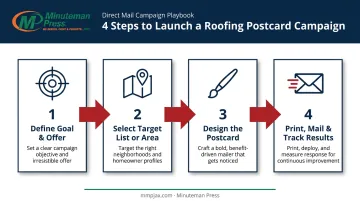
A roofing postcard campaign comes down to four steps:
- Define your goal and offer — free inspection, storm damage assessment, financing promotion, whatever fits your current capacity
- Select your target list or area — EDDM route, targeted property list, or a hybrid of both
- Design the postcard — bold headline, strong photo, trust signals, clear contact info
- Print, mail, and track results — measure response before planning your next drop
Handling all four steps with separate vendors invites delays and mismatched files. A full-service local printer that manages design, printing, and mailing coordination under one roof removes that friction. Minuteman Press in Jacksonville, for example, can take a roofing postcard from initial design through print and mail delivery. Keeping the project in one shop cuts errors and turnaround time.
Include a tracking mechanism from day one: a dedicated phone line, a printed promo code, or a QR code that logs scans. Without tracking, you're guessing at what worked. With it, you can refine your next mailing based on actual numbers instead of assumptions.
Frequently Asked Questions
What are roofing postcards?
Roofing postcards are direct mail pieces roofing companies send to homeowners to generate leads for repairs, replacements, or inspections. They typically combine a strong offer, trust signals, and contact information in a compact, print-ready format.
How much does direct mail postcard marketing cost for roofing companies?
Cost depends on postcard format, print quantity, and mailing method (EDDM versus a targeted list). Ask a print and mail provider to quote your exact size, quantity, and list or EDDM plan.
How do I get a mailing list of homeowners for roofing postcards?
You have three common options:
- Use EDDM for full carrier-route coverage with no list required
- Filter property-data tools by home age or storm history
- Buy a targeted homeowner list that matches your criteria
What size postcard works best for roofing direct mail?
Popular formats include 4x6, 6x9, and oversized or jumbo cards. Larger, sturdier cards usually stand out more in the mailbox—but your own A/B tests matter more than format alone.
How often should roofing companies send postcards to the same area?
Plan seasonal or quarterly drops to the same area. Roofing is a high-cost, infrequent purchase, so most homeowners need several touchpoints before they call.
What is a good response rate for roofing direct mail campaigns?
There's no published roofing-specific benchmark, but general direct mail response rates range roughly from 4% to 9% depending on list type. Your actual results will depend heavily on offer strength and targeting precision.
Visit Us in Jacksonville
Minuteman Press Jacksonville takes roofing postcards from initial design through print and mail delivery, including EDDM route selection and targeted list options that put your offer in front of the right homeowners. Call 904-733-5578 or stop by 4185 Sunbeam Road, Suite 100, Jacksonville, Florida 32257 to get your next postcard campaign started.