
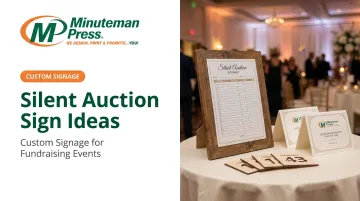
This happens at fundraising galas more often than organizers admit. Many event planners struggle with guests who hover near auction tables, unsure whether to write their name down or ask a volunteer. The result: confused bidders, overwhelmed staff fielding the same questions all night, and high-value items that quietly get overlooked.
Good signage solves this. This guide covers the sign types every silent auction needs, creative display ideas by category, design tips for readability, and placement strategies that keep bidding moving from doors-open to close.
Key Takeaways
- Clear signage builds trust, boosts bids, and cuts down on repetitive staff questions
- Every auction needs a mix of signs: item descriptions, bid sheets, directional, category, sponsor, and closing-time
- Themed and category-specific signage makes items like jewelry or travel packages feel more valuable
- Legible design and smart placement matter as much as clever wording
- Professional printing keeps signage polished, durable, and on-brand for the whole event
Why Silent Auction Signage Matters
A silent auction has no auctioneer standing at a podium explaining each lot. Signage does that job instead. It's the only thing telling a guest what an item is worth, who donated it, and how to bid on it, so it has to work harder than signage at almost any other event.
The same principles that drive retail displays apply at the auction table. Placement and visibility shape what guests notice first, and visual hierarchy decides which items draw bids.
Beyond bidding behavior, good signage solves three practical problems:
- Cuts time volunteers spend answering "What's the starting bid?" so staff can focus on donors
- Signals professionalism—polished, consistent signs build confidence in the organization
- Pulls attention to high-value lots where the real fundraising potential sits
A silent auction with clear, well-placed signs runs itself. One without it turns every volunteer into a walking FAQ desk.
Types of Silent Auction Signs Every Event Needs
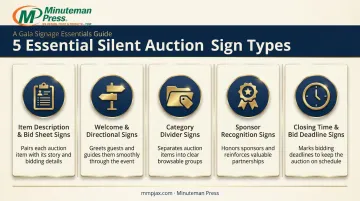
A successful auction relies on several distinct sign types working together, not one generic "Auction Here" placard by the door. Each type solves a different problem for guests as they move through the room.
Item Description & Bid Sheet Signs
These sit right next to each item and carry the details guests need to bid with confidence. Each one should include:
- A catchy item title (not just "Gift Basket #12")
- A short, benefit-driven description
- Estimated retail value
- Starting bid and minimum bid increments
- Donor credit
Keep the format consistent across every item so guests know exactly where to look for each detail.
Welcome & Directional Signs
These guide guests from the parking lot to the action. Without them, people wander, ask staff for directions, and miss check-in entirely. Place them at entrances, registration, restrooms, and the path toward auction tables.
Category Divider Signs
Grouping items under labeled sections such as Travel, Art, or Experiences helps guests browse related lots without backtracking across the room. Use the same section names on the printed catalog and the floor signage so guests aren't hunting for a table labeled differently than what's in their program.
Sponsor Recognition Signs
Thanking sponsors with logo placement builds goodwill and helps secure next year's support. A dedicated sign near the entrance or on auction tables, with clear logo visibility, keeps their brand in front of every guest who walks the room.
Closing Time & Bid Deadline Signs
Post closing times near each table, and announce them again as the deadline approaches. Clear reminders create urgency and help prevent that frustrating moment when someone realizes they missed the final bid by two minutes.
Creative Silent Auction Sign Ideas by Theme and Item Category
Matching sign design to your event's theme—garden party, travel gala, or black-tie dinner—creates a cohesive experience that feels planned, not thrown together. Colors, fonts, and small props on the sign can echo the theme without much extra cost.
Try these theme-matched treatments:
- Garden party: Soft greens, script headers, and botanical line art on item cards
- Travel gala: Map textures, destination callouts, and luggage-tag style bid cards
- Black-tie dinner: High-contrast black/gold type, minimal layouts, and clean serif fonts
- Sports night: Bold block type, team colors, and scoreboard-style starting bids
For jewelry displays: Use small elevated signs paired with focused spotlighting and a velvet or dark-fabric stand. The contrast signals luxury before a guest even reads the price. A plain paper sign taped to a folding table undercuts even a high-value piece.
For general item displays: Pair one large category sign with individual item cards at eye level. Use risers of varying heights so smaller items don’t get lost next to bigger ones. That height mix builds a clear hierarchy and pulls the eye across the whole table, not only the front row.
Extra tactics that lift bids:
- Add QR codes to signs for a short video, extra photos, or the mobile bidding page
- Lead with benefit-driven copy—"Bid Now, Sip Later" beats "Wine Basket, Value $75"
- Color-code categories with matching ribbons, balloons, or header bars on each table
Lead every description with appeal and value, not a flat contents list. Professionally printed category headers and item cards keep type crisp under event lighting and help the whole room feel intentional.
Design Tips for Eye-Catching, Readable Signs
None of these ideas matter if guests can't read the sign from three feet away in dim ballroom lighting. Legibility research on sign design points to one main factor: viewing distance determines everything else, including size, stroke width, and contrast.
A few practical rules:
- Use high-contrast color combinations. Dark text on a light background (or vice versa) reads faster than muted tones.
- Choose bold, sans-serif fonts sized for how far guests will stand when reading.
- Keep letter stroke width around one-fifth of the letter height for maximum readability, according to sign design research from the Sign Research Foundation.
- Reserve large, bold text for titles and key numbers like starting bids, and keep supporting copy in shorter bullet points rather than paragraphs.
DIY vs. Professional Printing
Canva and similar tools work fine for a small auction with a dozen items and a casual vibe. But once you're running a gala with 100+ lots, multiple rooms, and sponsors expecting polished recognition signage, DIY starts to show its seams. Inconsistent sizing, flimsy paper, and colors that shift from screen to print all undercut the look.
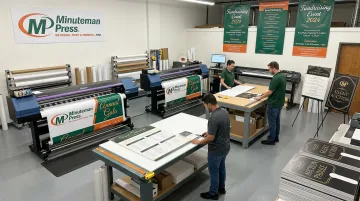
That's where a full-service print shop earns its keep. Minuteman Press in Jacksonville produces event-ready signage on foam core, banner material, and rigid substrates. Lamination is available when signs need to survive multiple events. For nonprofits finalizing details days before an event, quick turnaround matters just as much as design quality.
Where to Place Signs for Maximum Impact
Even a well-designed sign fails if it's in the wrong spot. Placement should match how guests actually move through the room, not just how the layout looks on a floor plan.
Place signs where guests naturally look and walk:
- Entrances and high-traffic pathways: Put welcome and directional signs here so guests can check in without stopping a volunteer
- Above table height: Hang larger signs on stands or from ceiling points—once the room fills, table-height signs disappear behind the crowd within about twenty minutes
- Beside or above each item: Keep item signs at eye level and tight to the lot so guests never guess which sign goes with which bid sheet
A simple rule of thumb: if a guest has to search for information, the sign is in the wrong place.
Frequently Asked Questions
How do I display items for a silent auction?
Place items at eye level, group similar items by category, and use risers to create visual variety in height. Pair every item with a clear, consistent description sign nearby.
How do I display jewelry for a silent auction?
Use elevated stands with spotlighting and a velvet or contrasting backdrop to signal luxury. Add a nearby sign listing value and description so guests understand what they're bidding on.
What size should silent auction signs be?
Sign size should scale with viewing distance. Keep item and bid sheet signs compact for close-up reading; make directional and welcome signs much larger so they’re visible across the room. When in doubt, size up rather than down.
Should I use digital or printed signs for a silent auction?
Digital displays offer real-time flexibility but require hardware, power, and setup. Printed signage is more reliable and cost-effective for a one-night event, and easy to replace if damaged.
How many signs do I need for a silent auction?
Plan on one sign per item, plus category dividers and directional signs throughout the venue. Exact counts scale with how many items you have and how large the space is.
Can I create silent auction signs myself, or should I hire a professional?
DIY tools work well for small, casual auctions. For larger galas or high-stakes fundraisers, a professional print shop like Minuteman Press delivers the polish and durability that matches the rest of the event.
Visit Us in Jacksonville
Minuteman Press Jacksonville produces event-ready signage for silent auctions, galas, and fundraisers - from item description cards and category dividers to sponsor recognition signs and foam core displays. Stop by or give us a call at 904-733-5578 to discuss your event's signage needs. Find us at 4185 Sunbeam Road, Suite 100, Jacksonville, Florida 32257.