That choice affects more than looks. A glossy finish can make a logo pop under store lighting, while a matte finish might read better outdoors or hold a handwritten note on a jar label. Get it wrong, and you end up with smudged fingerprints on a product label or a faded promo decal that looked great in the mockup but not on the bumper.
This guide breaks down the practical differences between glossy and matte stickers, so Jacksonville business owners can match the finish to the job, whether that's packaging, signage, or a giveaway at a trade show.
Key Takeaways
- Both finishes share the same durable, weatherproof base; only the top coat differs.
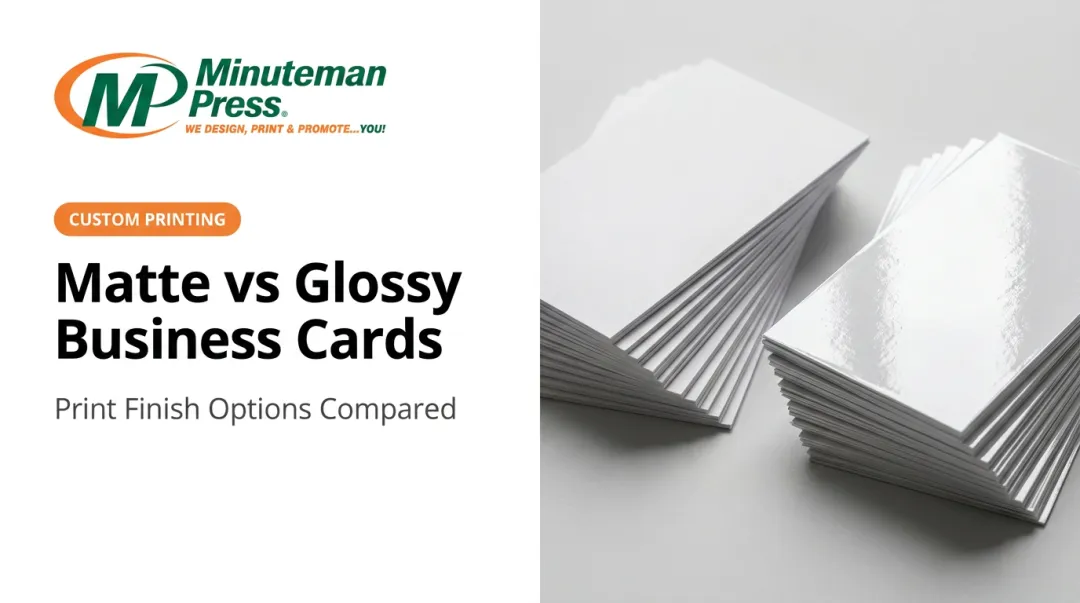
- Glossy reflects light for bold, saturated colors that stand out in retail or outdoor settings.
- Matte diffuses light for a soft, premium look and accepts pen ink cleanly.
- The right pick depends on your branding goals, lighting, and whether writing on the label matters.
- Testing both finishes on your actual design beats guessing before a bulk print run.
Glossy vs Matte Stickers: Quick Comparison
Here's how the two finishes stack up across the factors that actually matter for business use.
| Factor | Glossy | Matte |
|---|---|---|
| Appearance & color | Reflective, high-contrast, saturated | Non-reflective, muted, natural-looking |
| Glare & light | Can glare under direct light or in photos | Glare-free, readable from any angle |
| Texture | Slick; shows fingerprints and smudges | Soft-touch; resists prints and minor scratches |
| Writability | Needs a permanent marker | Takes standard pen ink cleanly |
| Outdoor durability | Slight edge in long-term UV resistance | Equally weatherproof; varies by laminate quality |
| Best for | Outdoor decals, bold packaging, promos | Product labels, minimalist branding, text-heavy designs |
A quick gut check: if your design needs to grab attention from ten feet away, glossy usually wins. If someone's going to hold the product and read the fine print up close, matte tends to perform better.
What Are Glossy Stickers?
Glossy stickers are vinyl or paper stickers finished with a reflective laminate or UV coating that boosts color saturation and adds shine. That reflective layer is what gives gloss its "pop" — colors look deeper, whites look brighter, and logos read as more vibrant under store or sunlight.
For businesses, the core benefit is standout shelf appeal. On a crowded shelf or a busy sidewalk, a glossy sticker catches the eye faster than a flat one. Most gloss laminates also carry solid UV protection, which helps printed colors resist fading longer under direct sun than some lower-grade matte options. That protection depends heavily on the specific laminate used, not the finish category alone.
Common gloss variations include:
- Gloss vinyl (for outdoor decals and signage)
- Gloss BOPP labels (common for bottles and jars)
- Spot-gloss accents (a glossy logo or highlight over an otherwise matte design)
Use Cases of Glossy Stickers
Gloss tends to show up wherever a brand needs maximum visual punch:
- Food and beverage packaging: bottle and jar labels that need to stand out on a shelf
- Sports and entertainment merchandise: bumper stickers, event giveaways
- Retail promotions: bold point-of-sale stickers and tags
- Automotive decals: window and bumper graphics
Shelf visibility research backs up why brands lean on reflective finishes. A Clemson University/FSEA study using eye-tracking technology found that foil-enhanced coffee packaging was noticed 1.5 to 2.5 times faster than identical unenhanced packaging, and 77% of shoppers preferred the enhanced version (FSEA Coffee Study).
Foil isn't the same as gloss laminate, but it points to the same principle: reflective surfaces earn attention faster in a crowded visual field.
Separate packaging research on personal-care products found glossy versions scored higher on purchase intention than matte versions in controlled testing (Journal of Product & Brand Management, 2019). That same study found no significant difference in what shoppers were willing to pay: gloss grabbed attention, but it didn't automatically justify a higher price.
What Are Matte Stickers?
Matte stickers use a non-reflective laminate that diffuses light instead of bouncing it back. The result is a soft, understated look that reads as more refined than shiny plastic.
That aesthetic supports a premium, modern identity. Matte finishes also photograph better under artificial light since there's no glare to fight with, a real advantage for brands that live on Instagram or rely on product photography for online sales.
Matte surfaces also resist fingerprints and light scratches, which matters for anything customers pick up and handle repeatedly.
Common matte variations include:
- Standard matte laminate (most product labels)
- Soft-touch / velvet matte — tactile, fabric-like feel favored by boutique and specialty brands
Use Cases of Matte Stickers
Matte finishes dominate in categories where tone and touch matter as much as color:
- Candle and skincare brands — labels that need to feel premium in-hand
- Craft and artisan packaging — supports a handmade, natural aesthetic
- Corporate branding — laptop stickers, folders, internal materials
- Health and wellness products — labels that need a clean, trustworthy look
A 2019 study in Marketing Letters tested ketchup packaging in matte versus glossy finishes and found participants rated the matte version as significantly more natural — 4.52 versus 3.43 on a rating scale (Marckhgott & Kamleitner, 2019).
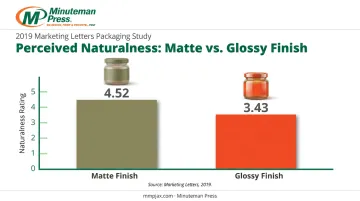
That perceived naturalness is why so many food, skincare, and wellness brands default to matte. It does not mean matte always beats gloss on "premium" perception. The naturalness effect was clear for food; other studies found gloss scored higher on general perceived quality for personal-care items. Context matters more than a blanket rule.
Glossy vs Matte: Which Finish Should You Choose?
There's no universal winner here. The right finish depends on three things: your brand personality, where the sticker will live, and what customers need to do with it.
Weigh these factors:
- Brand personality — Bold and energetic brands lean toward gloss. Refined and minimalist brands lean toward matte.
- Environment — Heavy outdoor sun exposure favors gloss slightly for UV resistance. Indoor or handled products work well either way.
- Functional needs — If customers write on the label (batch numbers, dates, personal notes), matte wins outright. Glossy requires a permanent marker and still smudges.
Quick situational guide:
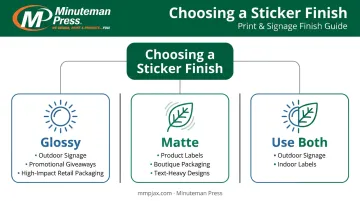
- Choose glossy for outdoor signage, promotional giveaways, and high-impact retail packaging.
- Choose matte for product labels, boutique packaging, and anything text-heavy or frequently handled.
- Use both — many businesses run gloss for outdoor signage and matte for indoor product labels, matching each finish to its strongest use case.
Since laminate quality varies by manufacturer and exposure conditions vary by placement, the smartest move is testing both finishes on your actual artwork before committing to a full run.
Minuteman Press in Jacksonville can walk you through label stock and finish options for your specific design. Reach out at 904-733-5578 or request an estimate through their online form before locking in a bulk order.
Conclusion
Neither finish is objectively better. Glossy wins on vibrancy and outdoor visibility; matte wins on sophistication, readability, and tactile feel. The right call depends entirely on where your sticker will live and what it needs to do once it gets there.
Match the finish to the use case — retail shelf, outdoor sign, product label, or promo giveaway — and the sticker will perform as well as it looks.
If you're not sure which way to go, Minuteman Press Jacksonville's print team can talk through your specific design and application before you commit to a full print run.
Frequently Asked Questions
Is a glossy or matte finish better?
Neither is universally better. Glossy suits bold, high-visibility designs, while matte suits premium, minimalist branding. The right choice depends on your intended use and environment.
Is glossy or matte better for car decals?
Glossy is usually preferred for car decals and bumper stickers for its strong UV resistance and outdoor shine. For vehicle applications, always confirm you're using a conformable, automotive-rated laminate.
Do glossy stickers fade?
Glossy stickers with quality UV laminate hold color well outdoors, but all stickers fade gradually after years of continuous sun exposure, regardless of finish. Florida's climate can accelerate this timeline compared to milder regions.
Can you write on matte stickers?
Yes. Matte's textured surface absorbs standard pen ink cleanly, making it easy to write on. Glossy stickers, by contrast, need a permanent marker since ink tends to bead or smear on the slick surface.
Which sticker finish lasts longer outdoors?
Both finishes are weatherproof when properly laminated. Glossy typically holds a slight edge in long-term UV and sun resistance for extended outdoor placements, but laminate quality matters more than the finish category itself.
What finish should I choose for product labels?
Matte is generally preferred for product labels because of its premium feel, easy readability, and fingerprint resistance. Glossy still works well for bold, colorful packaging designs meant to stand out on a shelf.
Visit Us in Jacksonville
Minuteman Press Jacksonville can walk you through glossy and matte sticker stock options on your actual artwork before you lock in a bulk order, so the finish you choose performs exactly as expected in real-world conditions. Call 904-733-5578 or visit 4185 Sunbeam Road, Suite 100, Jacksonville, Florida 32257 to review samples and get a quote for your label or decal project.