
This is a real headache for office managers and small business owners. Get it wrong one way, and you're drowning in boxes of expired marketing collateral. Get it wrong the other way, and you might shred something that documents a policy change or a milestone your company will want on record years from now.
This guide breaks down the difference between records and non-records, answers the brochure question directly, and flags a nuance most retention checklists skip entirely.
Key Takeaways
- Brochures are generally non-records: promotional materials with no unique administrative value.
- 36 CFR 1222.14 excludes brochures as "stocks of publications," not official records.
- Retain one official record set copy of each brochure version for institutional history.
- Non-record brochures can be discarded anytime — no formal approval required.
Records vs. Non-Records: The Basic Definitions
Before you can decide what to keep and what to pitch, you need a working definition of both terms. The federal government's framework, while written for agencies, gives businesses a solid model to borrow.
What Qualifies as a "Record"?
Under 44 U.S.C. 3301, a record is defined as recorded information made or received in connection with business activity and preserved as evidence of an organization's operations, decisions, or policies.
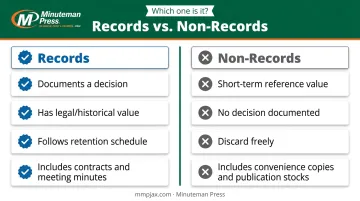
In plain terms: a record documents what happened and why. Common examples include:
- Signed contracts and vendor agreements
- Meeting minutes and board resolutions
- Emails documenting a policy decision
- Financial statements and tax filings
The common thread? Each one proves something happened, or captures a decision that shaped the business.
What Qualifies as a "Non-Record"?
Non-records are the opposite. They carry only short-term or reference value and don't document any legal, financial, or operational decision. Federal guidance at 36 CFR 1222.14 breaks non-record material into three buckets:
- Extra convenience copies – duplicates kept just for easy reference
- Library or museum reference material – items acquired solely for browsing or exhibit purposes
- Stocks of publications – bulk supply copies of things like catalogs, posters, and brochures
Misclassifying either direction creates problems. Treat a real record as disposable, and you might destroy something with legal or historical weight. Treat a non-record like a permanent record, and you're burning storage space (and staff time) on paper nobody will ever need again.
Are Brochures Non-Records? Here's the Direct Answer
Yes. In the vast majority of cases, brochures are non-records.
Institutional records management offices back this up consistently. Nicholls State University's official guide, for instance, lists "brochures and giveaways" directly under promotional content classified as non-records.
The reasoning is simple: brochures are mass-distributed marketing pieces. They don't capture a decision, an approval, or an action your organization took. They exist to be handed out, not kept as proof of anything.
The regulatory basis is 36 CFR 1222.14(c), which excludes "stocks of publications" — a category that explicitly names brochures, pamphlets, and posters held simply as reference or distribution supply.
A quick scope note: this classification applies to the bulk copies sitting in a box for handout purposes. It's not a blanket rule covering every single brochure your company will ever produce (more on that below).
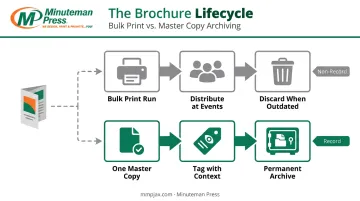
Practical example: Say your business prints 500 brochures for a spring trade show. Once the event wraps and a new design replaces the old one, you can toss the leftover stock without filing any disposal paperwork or getting sign-off from anyone. It's promotional supply, not documentation.
The Overlooked Nuance: When a Brochure Becomes an Official Record
Here's where most retention guides stop short, and it's the piece that actually matters most for businesses that care about their own history.
The National Archives requires federal agencies to maintain what's called a record set of their publications, including brochures, pamphlets, and annual reports, as part of their official history. Current rule text at 36 CFR 1222.14(c) makes this explicit: "record sets" of agency publications don't fall under the nonrecord stocks category.
The key distinction:
| Copy Type | Record Status |
|---|---|
| Bulk marketing and distribution copies | Non-record |
| One official file copy retained for institutional memory | Record |
Why does this matter for a small business? If a brochure announced a new service line, documented a rebrand, or accompanied a major policy shift, that single master copy carries real evidentiary and historical value.
Years from now, that copy might be the only proof of when and how your company communicated a change.
What this means for your business:
- Archive one copy of every brochure version you produce, even while treating the leftover print run as disposable
- If you're in a regulated industry like financial services or healthcare, check whether promotional pieces tied to specific disclosures need to stick around longer under sector-specific rules
- Don't assume "non-archival" means "throw it away tomorrow" — some state schedules keep duplicate publications for a set period before disposal, rather than immediately
That last point trips people up. A copy being non-permanent doesn't always mean it's disposable on day one.
Other Common Examples of Non-Records Beyond Brochures
Brochures aren't the only category businesses tend to over-retain. The same logic (temporary value, no decision documented) applies to:
- Early drafts without substantive edits or circulation for approval
- Routine or personal communications that don't require any administrative action
- Duplicate or convenience copies of documents where an official copy exists elsewhere
- Reference materials received but never acted on, such as trade journals or vendor catalogs
- Unsolicited junk mail and advertisements that require no response or action
Other promotional and giveaway items, such as branded pens, tote bags, or flyer stacks, follow the same logic. They carry temporary marketing value but document zero organizational decisions, so they're safe to discard once their useful life ends.
One caution: a draft only qualifies as a non-record if it was never circulated and contains no unique content. A draft that got emailed around for comment, or one that shows how a final decision came together, can actually count as a record. Don't let the label "draft" or "personal" do all the classification work for you.
Best Practices for Managing Brochures in Your Retention Policy
A simple two-tier system solves most of the confusion here.
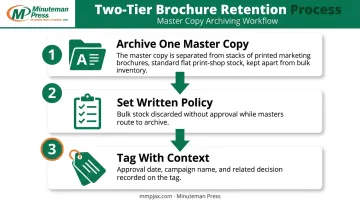
- Maintain one archived master copy of every brochure version, kept separate from the bulk marketing stock you'll eventually discard.
- Set an internal policy in writing: no approval needed to toss outdated promotional inventory, but the master file always gets routed to a permanent digital or physical archive before the stock goes anywhere.
- Tag the master with context (approval date, campaign name, or the decision it accompanied) so it's useful if someone pulls it years later.
This is where consistent, well-organized brochure production pays off twice: once for marketing, once for recordkeeping. If your brochures are inconsistently designed or you've lost track of which version was current when, that master archive becomes a lot less reliable.
Minuteman Press in Jacksonville handles the full production side of this equation for local businesses. Our design and printing capabilities cover everything from initial layout to reprint runs.
That range makes it easier to keep an accurate version history whenever your team needs to pull, update, or reprint a past brochure design. If you're building out a retention policy and need a reliable print partner, reach out to our Jacksonville team at 904-733-5578.
Frequently Asked Questions
Are brochures an example of non-records?
Yes, generally. Federal guidance classifies brochures as non-records because they're promotional stock materials rather than documentation of a decision or action taken by an organization.
What are non-essential records?
People often use "non-essential records" interchangeably with "non-records." Both terms describe materials with only temporary or reference value that aren't needed for legal, business, or historical documentation.
What is the difference between a record and a non-record?
A record documents a decision, transaction, or organizational activity and typically must be retained under a schedule. A non-record has only short-term value and can be discarded freely once it's no longer useful.
Do I need approval to destroy a brochure or promotional material?
No. Since brochures are non-records, you typically don't need formal disposal approval, unlike official records governed by a retention schedule.
Should I keep a copy of every brochure my company produces?
Yes, it's smart practice to retain one archival copy of each brochure version for historical and reference purposes, even while discarding bulk distribution stock once it's outdated.
What other promotional materials are considered non-records?
Flyers, catalogs, trade show giveaways, and general advertisements all fall into the same non-record category as brochures, since none of them document a business decision or action.
Visit Us in Jacksonville
Minuteman Press Jacksonville handles the full production side of brochure printing - from initial layout and design through reprint runs - making it straightforward to maintain a clean version history whenever your marketing materials are updated. Call 904-733-5578 or visit 4185 Sunbeam Road, Suite 100, Jacksonville, Florida 32257 to discuss your next brochure project.