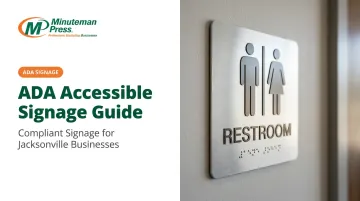
Here's the problem: most business owners think signage is a design decision. It isn't. Braille dot spacing, contrast ratios, mounting height, they're all federally mandated specifications, not preferences. Skip one and you risk a redesign, a fine, or a formal complaint.
This guide breaks down what ADA signage actually requires: which signs need to comply, the exact technical specs inspectors check, and how a Jacksonville sign shop like Minuteman Press helps you get it right the first time.
Key Takeaways
- ADA signage rules cover specific sign types, not every sign in your building
- Tactile characters must sit 48 to 60 inches above the floor, measured to the baseline
- Braille must be Grade 2 (contracted) and placed below corresponding text
- Non-compliance has led to real DOJ settlements and civil penalties
- Temporary signs, menus, and logos are generally exempt from these rules
What Is ADA Compliant Signage?
The Americans with Disabilities Act became law in 1990, but the technical rulebook businesses actually follow is the 2010 ADA Standards for Accessible Design. These standards spell out precisely how signage must communicate information to people with vision or other impairments.
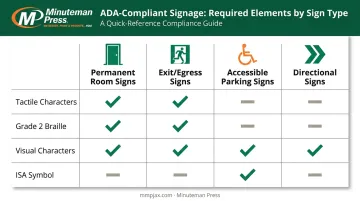
Compliant signage relies on a combination of formats—not all required on every sign:
- Visual characters with proper contrast, sized for the viewing distance
- Raised tactile characters readable by touch
- Grade 2 Braille placed beneath the tactile text
- Standardized pictograms, when a pictogram is used at all
Here's the part that trips people up: not every sign needs all four elements, and not every sign in your facility needs to comply at all. The ADA targets specific categories: permanent room labels, exits, accessible parking, and similar features.
Directional signs, for instance, only need to meet the visual requirements. We'll cover the full breakdown, including what's exempt, later in this guide.
Which Signs Are Required to Meet ADA Standards?
Section 216 of the ADA Standards determines when a sign must comply, while Chapter 7 sets the technical specs for how. The requirement depends entirely on what the sign identifies.
Permanent Room & Space Signs
Any sign identifying a room or space that isn't likely to change must include both tactile and visual elements when mounted at the door. Common examples include:
- Restrooms
- Room numbers
- Conference rooms
- Mechanical rooms
This is the category most people mean by ADA signage, and it's where raised characters and Braille are legally required.
Means of Egress & Exit Signs
Doors at exit stairways, exit passageways, and exit discharge points need tactile signage identifying them as such. This is separate from the illuminated exit signs your fire code already requires. You likely need both: one for life-safety code, one for ADA accessibility.
Accessible Parking, Entrances & ISA Signage
The International Symbol of Accessibility (ISA) must appear at:
- Accessible parking spaces
- Accessible entrances (unless all entrances are accessible)
- Accessible checkout aisles
- Accessible restrooms (unless all are accessible)
Parking signs carry two extra requirements: a 60-inch minimum mounting height to the bottom edge, and the words "Van Accessible" on any space designed for larger vehicles. Facilities with four or fewer total parking spaces are exempt from the parking-sign requirement, per federal rules.
Directional & Informational Signs
Signs pointing you toward the restroom, listing hours of operation, or posting rules of conduct only need to meet the visual character requirements. No tactile text or Braille is required here—only correct contrast, font, and sizing.
Skipping these requirements has real costs. In a 2004 DOJ settlement involving a Memphis Burger King, the business was cited for missing accessible-parking signs and signs directing customers to the accessible entrance. The Department of Justice case record shows the company agreed to correct the signage and pay a $5,000 civil penalty—an expense a compliant sign order would have avoided.
Key ADA Signage Requirements to Know
This is where the fine print lives, and where DIY signage most often fails inspection.
Tactile Characters & Braille
Raised characters must be:
- 5/8 inch to 2 inches in height, measured from the baseline
- Raised at least 1/32 inch above the sign surface
- Uppercase sans serif only—no italic or decorative faces
Grade 2 (contracted) Braille goes directly below the corresponding text, with a minimum 3/8-inch clearance from other tactile elements.
Both tactile and Braille content must sit within a 48-inch to 60-inch mounting zone, centered over an 18-by-18-inch clear floor space so someone can approach and read it by touch without obstruction.
Character Size, Contrast & Finish
Visual characters follow a different, distance-based sizing rule. According to the Access Board's official Chapter 7 signage guide, minimum character height increases as viewing distance grows, starting at 5/8 inch for close-range signs and scaling up for signs read from farther away.
Two more non-negotiables:
- Sharp contrast between characters and background—light-on-dark or dark-on-light
- Non-glare finish on both characters and background
Pictograms & the International Symbol of Accessibility
Rules differ by pictogram type:
- Permanent room labels: 6-inch minimum field height, with a tactile text descriptor below the image
- Informational pictograms (such as the ISA at an accessible entrance): finish and contrast rules only—no paired tactile text required
Sign Placement & Mounting Requirements
Getting the sign right doesn't help if it's mounted wrong. Placement rules are as strict as the character specs—and easier to fail on install day.
Mounting height: Tactile characters must sit in the 48-to-60-inch zone above the finished floor. Keep an 18 x 18-inch clear floor space in front for approach.
Door-side placement depends on your door configuration:
- Single door — sign goes on the latch side
- Double doors, one active leaf — sign goes on the inactive leaf
- Double doors, two active leaves — sign goes to the right of the right-hand door
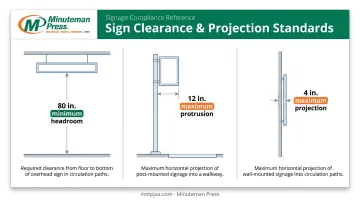
Post-mounted and overhead signs bring extra clearance rules:
- Overhead signs need 80 inches of minimum headroom
- Post- or pylon-mounted signs can't protrude more than 12 inches into a walkway
- Wall-mounted signs in a circulation path are limited to 4 inches of projection
Miss these clearances and you create a compliance issue and a real safety hazard.
Signs Exempt from ADA Requirements
Not every sign in your building has to comply, and knowing the exemptions keeps you from overspending on signage you don't need.
Recognized exemptions include:
- Temporary signs posted for 7 days or less
- Building addresses and directories
- Occupant names and company logos
- Wall-posted menus
- Seat and row designations in assembly areas
Exempt doesn't mean prohibited. It simply means that content isn't legally required to carry tactile characters or Braille.
One sign can also mix both. An occupant's name plate is exempt, but if that same sign includes a room number, the room number still has to meet full ADA specs.
Why Work with a Professional ADA Signage Provider
DIY and generic signage vendors miss small details constantly:
- Braille dot spacing that's a fraction off
- Contrast that doesn't quite meet spec
- Mounting height measured to the wrong reference point
Any one of these can fail an inspection and send you back to square one. You pay twice for a sign you thought was finished.
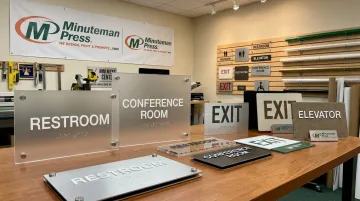
Minuteman Press in Jacksonville produces ADA Braille signage built to the 2010 Standards:
- Materials: acrylic, aluminum, or composite substrates depending on your application
- Finish: matte, non-glare surfaces for proper visual contrast
- Tactile characters: raised a minimum of 1/32 inch, per federal spec
- Braille: Grade 2 contracted Braille on every applicable sign
- Mounting guidance: latch-side placement with a 60-inch centerline, consistent with ADA Section 703
The shop also offers ADA compliance consultation and wholesale pricing for facility-wide or campus-wide projects, which matters if you're outfitting an entire building rather than a single door.
Getting a quote is straightforward:
- Online: submit project details anytime through the estimate request form
- Phone: call 904-733-5578
Whether you've got a sketch on a napkin or finished artwork ready to go, talk to the team before you order. Catching a compliance issue at the design stage costs a phone call. Catching it after installation costs a reorder, and potentially a fine.
Frequently Asked Questions
What is ADA compliant signage?
ADA-compliant signage meets the 2010 ADA Standards for Accessible Design. It uses visual characters, raised tactile text, and Grade 2 Braille so people with vision or other impairments get the same information as everyone else.
What is the minimum size for ADA signage?
Tactile character height must fall between 5/8 inch and 2 inches. Visual-only signs scale up in required size based on how far away they'll be read, with signs viewed from farther distances needing larger characters.
Do all businesses need ADA-compliant signage?
Any facility open to the public must comply for signs identifying permanent rooms, exits, and accessible features. Some signage, like temporary signs, menus, and name plates, is exempt from these rules.
What happens if my signage isn't ADA compliant?
You risk fines, formal complaints, and mandatory sign replacement, plus full replacement costs. Non-compliant signage also creates real barriers for customers and employees with disabilities.
Can I make my own ADA signage, or do I need a professional?
It's technically possible, but Braille spacing, contrast ratios, and mounting height are easy to get wrong without specialized equipment and knowledge. A professional sign shop verifies these details before production, not after installation.
How high should ADA signage be mounted?
Tactile characters must be mounted 48 to 60 inches above the finished floor, measured to the character baseline. Exact placement also depends on your door type—single doors, double doors with one active leaf, or two active leaves.
Visit Us in Jacksonville
Minuteman Press Jacksonville produces ADA-compliant Braille signage built to the 2010 Standards, covering everything from restroom and room labels to exit and accessible parking signs. Stop by the shop at 4185 Sunbeam Road, Suite 100, Jacksonville, Florida 32257 or reach the team at 904-733-5578 to get a quote or discuss a facility-wide compliance project before your next inspection.