You're comparing business card options, and suddenly you're asked to choose between 14pt, 16pt, and 18pt stock without any real explanation of what those numbers mean for your final product.
Here's why it matters: cardstock thickness directly affects how durable your print piece is, how sharp your colors look, and how your brand feels in someone's hand. A flimsy business card gets tossed. A sturdy one sits on a desk.
This guide breaks down exactly what 16pt cardstock means, how it stacks up against 14pt and 18pt options, and when it's the right call for your next print project.
Key Takeaways
- 16pt cardstock is 0.016 inches thick—mid-to-heavy stock built for business cards and postcards
- Printers specify cardstock by thickness (pt), not by paper weight
- 16pt is the maximum thickness USPS allows for First-Class Mail card rates
- Choose 16pt over 14pt when durability and a premium feel matter more than cost
What Is 16pt Cardstock?
"Pt" stands for point, a printing industry unit where 1 point equals 1/1000th of an inch. According to Mohawk's paper selection guidance, a 0.016-inch substrate is classified as 16-point stock.
This is a critical distinction: point measures thickness, not weight. A common mistake is assuming a higher point number means a heavier sheet in the traditional sense. It actually refers to how thick the paper caliper is when measured with precision tools.
Thickness in Inches and Millimeters
Here's the direct conversion:
- 16pt = 0.016 inches
- 16pt ≈ 0.406mm (some manufacturers round this to 0.407mm)
This places 16pt squarely in the range most commercial printers consider standard for cardstock projects, generally spanning 14pt to 18pt. This isn't an official, universally binding standard. Rather, it reflects the thicknesses most commonly stocked and requested across the printing industry.
How Many Pounds Is 16pt Cardstock?
Converting point thickness to pound weight gets messy fast, and there's a good reason for that.
Manufacturer data shows nominal 16pt stock typically falls between 106 and 132 lb Cover weight, or roughly 288 to 353 GSM, depending on the mill and coating, according to Sappi's Spectro product specifications. That's a wide range for what sounds like one simple measurement.
The confusion often comes down to terminology:
- Cover weight refers to paper measured against a 20 x 26-inch base sheet
- Text weight refers to paper measured against a 25 x 38-inch base sheet
Because the starting sheet sizes differ, an "80 lb" text sheet and an "80 lb" cover sheet aren't remotely similar in actual thickness or rigidity. This is exactly why relying on pound weight alone can mislead you.
Point thickness sidesteps that confusion entirely. It's a direct physical measurement, which is why most commercial printers default to describing cardstock in points rather than pounds.
16pt vs 14pt vs 18pt Cardstock: How Do They Compare?
The most common decision point for business owners isn't 16pt versus 18pt. It's 14pt versus 16pt, since these two are the workhorses of the business card and postcard world.
The difference sounds tiny on paper: 0.014 inches versus 0.016 inches. In your hand, it's noticeable.
Durability and rigidity. Thicker stock resists bending, creasing, and general wear better over time. A 16pt card holds its shape after months in a wallet; a 14pt card is more prone to soft corners and curling edges.
Feel and perceived quality. According to Mohawk's printer guidelines, heavier stock creates a perception of sturdiness and dependability. That perception translates directly into how a potential client sizes up your brand within seconds of touching your card.
Print quality and ink vibrancy. This one's nuanced. Vibrancy is driven more by coating and surface finish than by thickness alone. That said, coated 16pt stock is frequently paired with premium coatings that produce sharper double-sided prints, which is why thickness and coating often get credited together.
What about 18pt? It's the next step up, offering maximum rigidity for luxury card products. Think high-end law firms, boutique consultants, or luxury real estate agents wanting their card to feel almost like a small plaque.
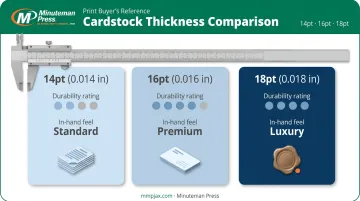
Here's a quick reference:
| Feature | 14pt | 16pt | 18pt |
|---|---|---|---|
| Thickness | 0.014 in | 0.016 in | 0.018 in |
| Durability | Good | Very good | Excellent |
| In-hand feel | Standard | Premium | Luxury |
| Best for | High-volume handouts, budget projects | Business cards, postcards, most premium print | Luxury cards, statement pieces |
Key Benefits of 16pt Cardstock
16pt cardstock solves specific, practical problems that thinner stocks struggle with.
Built to last. Thicker stock handles repeated handling, mailing, and storage far better than thinner alternatives. A 16pt business card survives months in a wallet without curling at the edges.
Professional impression. A heavier card in someone's hand subtly signals that your business invests in quality. That perceived value boost is why 16pt is often chosen over 14pt for client-facing pieces.
Finish flexibility. 16pt performs well across nearly any finish without losing its sturdy feel:
- Matte for a subdued, professional look
- Gloss for vibrant, eye-catching color
- Uncoated for a natural, tactile texture
You don't have to sacrifice durability to get the visual style you want.
Best Uses & Applications for 16pt Cardstock
Shops reach for 16pt when a piece needs to feel substantial and hold up to handling. Common applications include:
- Business cards for client-facing roles where first impressions carry weight
- Postcards that need to survive handling and mailing
- Invitations for events where presentation matters
- Menus that get passed between hands repeatedly
- Door hangers exposed to weather and rough handling
Direct mail is where 16pt earns its keep. According to USPS Postal Explorer, 16pt hits the 0.016-inch maximum allowed for First-Class Mail card pricing.
That thickness helps postcards survive sorting machines and mail handling without bending, so they arrive in the same condition they left the press.
Minuteman Press Jacksonville handles the full process under one roof, from design through printing and mailing. Jacksonville businesses running direct mail campaigns don't need to juggle multiple vendors for postcards, business cards, or EDDM pieces.
Finishing Options That Pair Well with 16pt Cardstock
16pt stock has enough body to take coatings and raised effects without warping or losing definition.
Common pairings include:
- Matte finish: Subdued and professional. The non-gloss surface takes ink and handwriting well, so clients can jot notes on the back of a card.
- Gloss or UV coating: Boosts color vibrancy and adds a protective layer. A strong pick for postcards and marketing pieces where visual impact drives response.
- Foil, embossing, and spot UV: Heavier caliper holds crisp impressions and texture better than thinner stock. Embossing especially needs that extra thickness for a clean, defined raise.
Choosing the Right Cardstock for Your Project
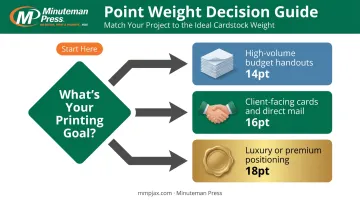
The right cardstock depends on what your project needs to accomplish.
A simple way to decide:
- Choose 14pt if you're distributing high volumes on a tight budget, such as event handouts or temporary promotional cards.
- Choose 16pt if lasting impressions matter more than shaving pennies off the print cost, such as client-facing business cards or direct mail.
- Choose 18pt if you want maximum rigidity for premium or luxury positioning, such as high-end invitations or executive leave-behinds.
Before committing to a full print run, get a physical sample in hand. Thickness and texture are hard to judge from a screen, and what looks fine in a digital mockup can feel underwhelming once printed.
If you're weighing 14pt against 16pt for an upcoming project, Minuteman Press Jacksonville's print team can walk through stock options, finishing choices, and turnaround timelines based on your specific goals.
Frequently Asked Questions
What does 16pt cardstock mean?
"16pt" refers to the paper's thickness, measuring 0.016 inches. It's a standard industry measurement describing caliper, not the paper's weight.
What is the difference between 14pt and 16pt cardstock?
16pt is thicker, more rigid, and delivers a more premium in-hand feel. 14pt is thinner, more flexible, and typically more budget-friendly for high-volume projects.
How many lbs is 16pt cardstock?
16pt typically ranges from 106 to 132 lb Cover weight, or roughly 288 to 353 GSM. Exact weight can vary slightly by mill and coating.
Is 16pt cardstock good for business cards?
Yes, it's one of the most popular choices for business cards. Professionals often choose 16pt specifically for the premium first impression it creates with clients.
What is the difference between 16pt and 18pt cardstock?
18pt is even thicker and more rigid than 16pt, typically reserved for luxury card products where maximum sturdiness matters most.
Can 16pt cardstock be used for postcards or direct mail pieces?
Absolutely. 16pt is well-suited for postcards and direct mail because its thickness resists bending during handling, sorting, and mailing.
Visit Us in Jacksonville
Minuteman Press Jacksonville stocks cardstock from 60# through 100# cover weight and can put physical samples in your hands so you feel the difference between 14pt, 16pt, and 18pt before committing to a full print run. Call 904-733-5578 or visit 4185 Sunbeam Road, Suite 100, Jacksonville, Florida 32257 to discuss stock options and finishing choices for your next project.