
Introduction
Inboxes are drowning. The average person deletes dozens of marketing emails without a second glance.
Direct mail doesn't have that problem: physical ads get remembered faster and more confidently than digital ones, according to USPS-backed neuroscience research using eye-tracking and fMRI.
Folded self mailers push that advantage further. No envelope to open, no barrier between your message and your reader. The design is visible the second it lands in the mailbox.
But many businesses get stuck choosing a format. Postcards feel too small for a real message. Letter packages with envelopes add cost, glue, and extra production steps.
This guide covers what a folded self mailer is, the USPS size and tabbing rules to follow, design strategies that work, and real-world use cases. You'll also see how Minuteman Press in Jacksonville can produce and mail one for you.
Key Takeaways
- Folded self mailers skip the envelope, giving recipients instant visual impact
- USPS size, weight, and tabbing rules (revised 2013) control mailability and postage
- Most pieces under 1 ounce now require two tabs, not one
- Match fold style to message complexity, from bi-fold offers to multi-panel product stories
- Minuteman Press Jacksonville handles design, printing, folding, and mailing in-house
What Is a Folded Self Mailer?
A folded self mailer is a single printed piece, folded and sealed with tabs or glue, then mailed without an envelope. USPS defines it as two or more panels created when a sheet (or sheets) of paper is folded and closed together into a letter-size mailpiece.
Each fold creates a new panel, and each panel carries part of the message:
- Front panel: grabs attention before the piece is even opened
- Inside panels: build the case, explain the offer, add proof points
- Back panel: closes the loop with a call-to-action or contact details
No panel is wasted space. That's the real advantage over a postcard, where you get exactly two sides and nothing more.
Common Fold Styles
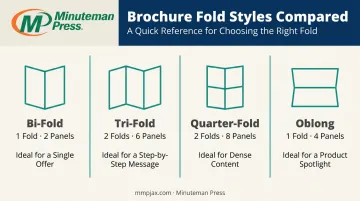
Your fold style determines how much room you have to tell your story:
- Bi-fold: one fold, two panels. Simple, budget-friendly, and ideal for a single offer or announcement
- Tri-fold: two folds, three panels. Good for a step-by-step message: problem, solution, offer
- Quarter-fold: two perpendicular folds turning one sheet into four panels. Works well for denser content like menus or service guides
- Oblong: one fold creating elongated panels, often used for product spotlights or mini catalogs
More panels mean more room, but also more production complexity. Match the fold to the message, not the other way around.
Folded Self Mailer vs. Postcard vs. Envelope Letter
| Format | Space | Production Cost | Perceived Formality |
|---|---|---|---|
| Postcard | Minimal (2 sides) | Lowest | Casual, quick-glance |
| Folded Self Mailer | Multiple panels | Moderate | Balanced, story-driven |
| Envelope Letter | Highest (letter + inserts) | Highest (envelope + insertion) | Most formal |
Postcards work for a quick coupon. Envelope letters suit formal correspondence like renewal notices. A folded self mailer sits in between: enough room to tell a real story, without the extra cost of an envelope and its insertion step.
USPS Size, Weight & Panel Requirements
USPS treats folded self mailers as a distinct category with tighter rules than standard letters or postcards. According to USPS Domestic Mail Manual 201.3.14, a compliant piece must be:
- Height: 3-1/2 to 6 inches
- Length: 5 to 10-1/2 inches
- Thickness: at least 0.007 inch (0.009 inch if over 4-1/4 inches high or 6 inches long), maximum 1/4 inch
- Weight: 3 ounces maximum
- Shape: rectangular, with an aspect ratio between 1.3 and 2.5
Here's the detail most first-time mailers miss: the maximum size for a folded self mailer is 6" x 10.5", smaller than the maximum allowed for a standard letter or postcard. Design to standard letter or postcard maximums and the piece can be rejected or reclassified.
Paper Weight & Panel Rules
Paper weight requirements depend on final weight and construction:
- Standard fold (bi-fold, tri-fold, quarter-fold): 70 lb book stock through 1 oz, 80 lb over 1 oz through 3 oz
- Die-cut or perforated pieces: 100 lb through 1 oz, 120 lb over 1 oz
- Pieces with loose enclosures: 80 lb through 1 oz, 100 lb over 1 oz
Panel count generally maxes out at 12, though quarter-folds on 70 lb stock can run as few as four panels, and heavier newsprint quarter-folds require 8 to 24.
Outside panels must be equal or nearly equal in size. Any flap needs to meet minimum size thresholds and be secured properly.
Avoiding Costly Non-Compliance Penalties
A piece that misses these specs loses eligibility for automation and machinable pricing—and you pay nonmachinable rates instead.
Before you print thousands of copies, run a compliance check. A print and mail partner like Minuteman Press can catch sizing, weight, and panel issues before they turn into unexpected postage costs.
Tabbing & Sealing Requirements for Folded Self Mailers
Tabs and glue aren't decoration. They're what keeps a folded piece intact as it moves through USPS automated processing equipment. A loose flap can jam machinery or tear apart mid-sort, and a torn piece rarely reaches its destination looking professional.
The 2013 Rule Changes
USPS revised its folded self-mailer standards effective January 2013, with clarifications following in May of that year, according to the USPS Postal Bulletin update. Two changes matter most:
- Final folds are no longer allowed at the top of the piece
- Bi-fold, tri-fold, and quarter-fold pieces under 1 ounce now require two tabs, not one
Tab Placement Rules
Acceptable placement options:
- Two tabs on top, within 1 inch of the leading and trailing edges
- One tab on the leading edge and one on the trailing edge, within 1 inch of the top
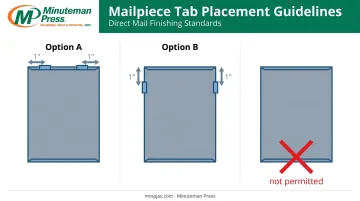
Tabs are no longer permitted on the bottom edge under any configuration.
Special Cases by Fold Style
For tri-fold pieces, put the address on the middle panel so the final fold forms the non-address side. If you address the final panel instead, add a tab or glue spot on the leading edge.
For oblong pieces, the final fold must sit on the leading (right) edge, with tabs centered on the top and trailing edge.
Materials & Loose Inserts
Approved tab materials include:
- Paper and translucent paper
- Vinyl and plastic tabs
- Glue lines or glue spots
If your piece has a loose insert and the bottom edge is open, anchor it securely so it doesn't shift during handling and sorting.
Design Tips to Maximize Your Folded Self Mailer
The front panel does the heavy lifting. It has one job: make the recipient want to unfold the piece. That means sparking curiosity while staying visually consistent with what's inside, not teasing something the interior doesn't deliver.
Visual impact matters more than most copywriters want to admit. People process images faster than text, so:
- Use high-resolution photos or graphics, never stretched or pixelated
- Leave ample white space rather than cramming every panel
- Make graphics support the offer, not just decorate the page
Copy That Carries Readers Through Every Panel
Short headlines. Scannable sentences. A clear call-to-action on every panel, not just the last one.
A simple structure that works across most campaigns:
- Front panel: the hook or headline offer
- Inside panels: the proof, details, or story
- Back panel: the ask, whether that's a phone number, QR code, or store visit
Every panel should logically lead to the next, so a reader flows from curiosity to action without hitting a dead end.
Examples & Best Use Cases for Folded Self Mailers
Folded self mailers fit campaigns that need more room than a postcard without the cost of a full envelope package. Common applications include:
- Grand opening announcements
- VIP or friends-and-family sale invitations
- Seasonal coupons and promotions
- Product launch pieces
- Customer onboarding or renewal reminders
Retail, healthcare, telecom, startups, and local service businesses lean on this format heavily. They often need to communicate multiple offers, services, or steps—but don't need heavy personalization for every recipient.
One Layout Idea You Can Steal
Try this structure for your next campaign: problem on the front panel, solution and proof points inside.
A home services company might structure it like this:
- Front panel: "Is Your AC Ready for Summer?"
- Interior panels: Seasonal maintenance tips, a limited-time discount, and a scheduling number
It's simple, and it maps directly to how people make decisions: recognize a problem, then look for the fix.
Why Partner With Minuteman Press for Your Folded Self Mailer
Coordinating a folded self mailer across separate vendors creates unnecessary friction. One shop handles design, another printing, a third mailing—and every handoff is a chance for specs to get lost or deadlines to slip.
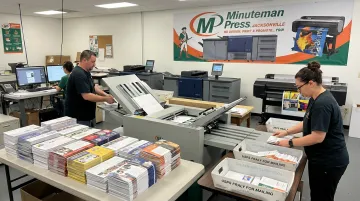
Minuteman Press Jacksonville handles the entire process under one roof:
- Design and copywriting, whether you bring your own files or need a layout built from scratch
- In-house folding (double parallel, tri-fold, z-fold, and engineering folds) with scoring for heavier stocks
- Mailing list procurement or Every Door Direct Mail (EDDM) for blanket geographic coverage
- Barcoding, sorting, and mail preparation built to USPS specifications
USPS tabbing and sizing rules leave little margin for error. Getting expert eyes on your specs before a production run helps you avoid the postage penalties and processing delays covered earlier in this guide.
Ready to get your folded self mailer campaign moving? Contact Minuteman Press Jacksonville at 904-733-5578 to ask for a consultation or quote.
Frequently Asked Questions
What is a folded self-mailer?
A folded self-mailer is a printed piece that's folded and sealed with tabs or glue, then mailed without an envelope. Its design is visible immediately, and content unfolds across multiple panels.
What are some examples of folded self-mailers?
Common examples include grand-opening announcements, coupon mailers, VIP sale notices, product launch pieces, and renewal or onboarding reminders. Retail, healthcare, and local service businesses use them frequently.
What are the tabbing requirements for USPS folded self-mailers?
Most folded pieces under 1 ounce need two tabs, either both on top or one on the leading edge and one on the trailing edge. Tabs are not permitted on the bottom edge.
How much does it cost to print and mail a folded self-mailer?
Cost depends on paper stock, fold style, quantity, and postage class. Request a quote from Minuteman Press in Jacksonville for an estimate based on your specs.
How many panels can a folded self-mailer have?
Most folded self-mailers top out at 12 panels. Quarter-folds on lighter stock can run as few as 4; heavier newsprint versions may reach 24.
What paper weight is required for a folded self-mailer?
Standard folded pieces need at least 70 lb stock through 1 ounce, and 80 lb over 1 ounce through 3 ounces. Die-cut or perforated pieces require heavier stock starting at 100 lb.
Visit Us in Jacksonville
Minuteman Press Jacksonville handles every step of your folded self mailer campaign - design, printing, folding, and USPS-compliant mailing - all under one roof at 4185 Sunbeam Road, Suite 100, Jacksonville, Florida 32257. Reach out at 904-733-5578 to get expert eyes on your specs and avoid postage penalties before a single piece goes to press.