Introduction
Scroll fatigue is real. After years of endless feeds and pop-up ads, shoppers are rediscovering the simple pleasure of flipping through a printed catalog while researching purchases online. Many businesses assume catalogs are relics of a pre-internet era, best left to nostalgia.
That assumption costs them. 79% of marketing executives now identify direct mail as their best-performing channel, and two-thirds of consumers read their mail the same day it arrives, according to USPS Delivers research on direct mail ROI. Print catalogs, paired with the right strategy, still convert.
This guide breaks down catalog types, the data behind their staying power, practical best practices, real brand examples, and mistakes that drain marketing budgets. By the end, you'll know exactly how to build a catalog that earns its place in the mailbox.
Key Takeaways
- Catalogs paired with digital tracking deliver measurable ROI, not just brand awareness
- Format choice (full-line, promotional, or brand-focused) depends on your sales goal and audience stage
- Segmentation and a single clear call-to-action drive most of the response-rate differences
- Local print and mail partners help avoid costly production or postal compliance errors
- IKEA, L.L. Bean, and Williams-Sonoma show catalogs scale from mass-market to niche audiences
What Is a Direct Marketing Catalog?
A direct marketing catalog is a printed or digital booklet that lets customers browse and order products directly from the sender, skipping the retail middleman entirely. No storefront required.
This is where the term catalog merchant comes from. A catalog merchant is a business that sells primarily or exclusively through catalogs instead of physical stores.
The U.S. government even tracks this as its own industry category: NAICS code 454110, covering "Electronic Shopping and Mail-Order Houses" — businesses that retail merchandise through nonstore means like catalogs.
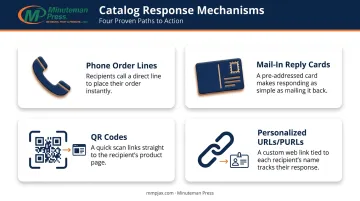
Catalogs sit within the broader direct marketing umbrella, distinct from mass advertising, because they always include a built-in response mechanism:
- Phone order lines
- Mail-in reply cards
- QR codes linking to product pages
- Personalized URLs (PURLs) tied to a specific recipient
That direct call-to-action is what separates a catalog from a magazine ad or billboard. Every page is designed to move someone from "browsing" to "buying," which is exactly why measuring catalog performance is more straightforward than most marketers expect.
Types of Direct Marketing Catalogs
Choosing the right catalog format is the foundation of any strategy. Each type serves a different stage of the buyer journey, from casual browsing to seasonal urgency to long-term brand loyalty.
Format also affects size and cost. Some campaigns call for a full 100-page book, while others work better as a mini-catalog under 10 pages or even a tri-fold micro-catalog mailed as a postcard.
Full-Line Catalogs
Full-line catalogs list an entire product range, including every variant and configuration. Manufacturers and retailers with large inventories rely on these as a one-stop reference their customers keep on hand.
This depth comes with tradeoffs:
- Higher production costs due to page count and complexity
- Longer design and proofing timelines
- Greater value for loyal, repeat customers who order across categories
Promotional Catalogs
These are the most common catalog types, built around curated selections such as seasonal offers, holiday gifts, or new product launches. A holiday gift guide mailed in early November, for example, creates urgency ahead of peak shopping season and drives short-term sales spikes rather than long-term browsing.
Informational/Brand Catalogs
Also called "magalogs," these blend product content with editorial storytelling to build brand identity rather than push immediate sales. Restoration Hardware's Source Books are a well-known example, combining design inspiration with product offerings. Businesses use this format to nurture loyalty over time, not close a transaction on page one.
Why Direct Mail Catalogs Still Deliver Results
Skeptics point to digital marketing's lower cost per impression. Fair point. But cost per impression isn't the same as cost per conversion, and catalogs win on retention.
Physical media generates 70% higher brand recall than digital advertising, according to a neuromarketing study conducted by Canada Post. The same research found direct mail holds attention significantly longer than a scrolling feed. Print requires less cognitive effort to process, which means the message actually sticks.
Catalogs earn their keep in a few concrete ways:
- Longer shelf life: Recipients keep catalogs an average of 20.3 days, giving the brand repeated exposure instead of a single glance
- Omnichannel support: QR codes, embedded URLs, and printed promo codes drive traffic to both e-commerce sites and physical stores
- Precision targeting: Mailing list segmentation by purchase history, geography, or demographics increases relevance and cuts wasted spend
- Brand-building power: IKEA and Pottery Barn use catalogs to sell a lifestyle, not just a product SKU, creating an aspirational pull a listing page rarely matches
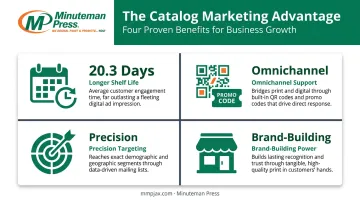
None of this replaces digital marketing; it complements it, giving brands a tactile touchpoint that fleeting ads simply can't match.
Building a Winning Catalog Marketing Strategy: Best Practices
A successful catalog campaign starts before a single page is designed. You need a clearly defined target audience, built from purchase history, demographics, and geographic data, so the right people receive the mailing in the first place.
Next, decide on one compelling call-to-action. Order online. Call this number. Redeem this code. Trying to push three different actions on one page usually results in none of them getting taken.
Design and Production Quality
High-quality photography, clean layout, and consistent branding make a catalog feel premium rather than disposable. Williams-Sonoma and Restoration Hardware take this approach, producing catalogs that read more like lifestyle magazines than sales flyers.
A few production details matter more than most businesses realize:
- Use 10-point type or larger with simple, legible fonts
- Avoid shiny-coated paper or reverse type, which can interfere with automated mail processing
- Keep layouts uncluttered so the eye lands on the offer, not the noise around it
Partnering with a Full-Service Print & Mail Provider
Design is only half the job. Printing, binding, mailing list management, and postal compliance all have to come together on schedule. Working with an established local partner, such as Minuteman Press in Jacksonville, means design, printing, binding, and mail distribution happen under one roof instead of being split across three vendors who don't talk to each other.
That coordination matters. A missed compliance requirement or a binding error can push a mailing back weeks, and holiday timelines don't offer that kind of flexibility.
Tracking and Measuring Response
You can't improve what you don't measure. Practical tracking methods include:
- Unique promo codes printed on each catalog variant to track which segment responded
- Dedicated landing pages that isolate catalog-driven web traffic from other channels
- Call tracking numbers specific to the mailing, so phone orders get attributed correctly
Before a full rollout, test variables like mailing frequency, catalog size, or offer type on a smaller segment. It's cheaper to learn from 5,000 pieces than from 50,000.
Real-World Catalog Marketing Examples
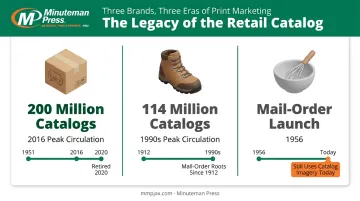
Major retailers built their brands on catalog marketing before pulling back or evolving their approach:
- IKEA mailed 200 million catalogs annually at its 2016 peak, retiring the format in 2020 to focus on digital channels
- L.L. Bean grew circulation to 114 million catalogs in the 1990s, building on a mail-order model dating to 1912
- Williams-Sonoma launched as a mail-order business in 1956 and still uses catalog imagery to reinforce its premium positioning
Smaller, regional businesses can apply the same principles without the massive print runs:
- Focus on one niche audience instead of a broad list
- Keep a consistent mailing schedule, even if it's quarterly rather than monthly
- Add a QR code or personalized URL to bridge print and digital, just as larger retailers do
Even a modest 500-piece seasonal mailer can generate the loyalty benefits typically associated with national catalog brands, provided the targeting and offer are sharp.
Common Catalog Marketing Mistakes to Avoid
Most catalog underperformance traces back to a handful of avoidable errors:
- Mailing to outdated or unsegmented lists. This wastes budget on recipients who were never a fit and drags down response rates across the board.
- Overcrowded layouts with unclear offers. If a reader can't identify the single action you want them to take within a few seconds, they'll take none.
- Skipping a trusted print and mail partner. Production errors and postal compliance mistakes cause delays and add costs that erase any DIY savings.
Each of these is fixable with planning. Partnering with Minuteman Press for design, printing, and mailing under one roof helps you catch these issues before they reach the mailbox.
Frequently Asked Questions
What is a direct marketing catalog merchant?
A catalog merchant is a business that sells goods primarily through printed or digital catalogs rather than a traditional storefront. Customers order by phone, mail, or online instead of visiting a physical location.
What are examples of catalog marketing?
IKEA, L.L. Bean, and Williams-Sonoma are well-known national examples. A small business version might look like a seasonal promotional mailer sent to past customers ahead of a holiday sale.
What is included in direct marketing?
Direct marketing covers direct mail and catalogs, email, telemarketing, text marketing, and direct selling. Every channel shares the same trait: a direct call-to-action tied to a measurable response.
Are catalogs still effective in the digital age?
Yes, especially when paired with digital tracking tools and targeted mailing lists. One study found adding print catalogs to a marketing mix produced a 28% lift in sales and 600% ROI.
How much does it cost to create a direct mail catalog?
Costs vary based on print quantity, paper quality, page count, and mailing list size. Minuteman Press can provide an accurate quote based on your project's specific details.
How do I build or buy a mailing list for catalog marketing?
You can use your own customer database, purchase a targeted list from a list broker, or work with a full-service mailing provider. Each option can help you build a compliant, segmented list suited to your catalog's audience.
Visit Us in Jacksonville
Minuteman Press Jacksonville handles catalog design, printing, binding, and mail distribution under one roof, so your direct mail catalog campaign stays on schedule without the delays that come from coordinating separate vendors. Call 904-733-5578 or visit 4185 Sunbeam Road, Suite 100, Jacksonville, Florida 32257 to get a quote on your next catalog project.