Many drivers, especially newer ones, aren't sure what it's telling them to do. Property owners run into the same confusion from the other direction. If you manage an HOA, a farm, or a private industrial road and need this exact sign installed, figuring out where to source a compliant one isn't always obvious either.
This guide breaks down what the sign means, what you should do when you see it, how it differs from similar warning signs, the compliance rules behind it, and where to get a custom one made if your property needs it.
Key Takeaways
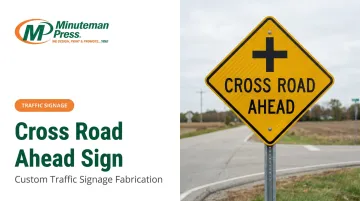
- The Cross Road Ahead sign (MUTCD code W2-1) warns of an upcoming four-way intersection, not a right-of-way rule.
- Right-of-way comes from stop or yield signs at the intersection—not from the warning sign itself.
- Expect them most often on rural, low-volume, or uncontrolled roads.
- 7,832 traffic fatalities in 2022 involved unsignalized intersections, per FHWA.
- Private property owners can order MUTCD-style signs without government approval.
What Is a Cross Road Ahead Sign?
The Cross Road Ahead sign is a warning sign, neither a regulatory sign nor a guide sign. Its entire job is to alert drivers that an intersecting road crosses the main roadway ahead, typically at close to a right angle, and that turning or entering traffic is possible. It doesn't tell you who has to stop. It just tells you something is coming.
You'll recognize it instantly because every warning sign in the U.S. shares the same visual language: a yellow diamond with a black symbol and border. That consistency is intentional.
The Federal Highway Administration's Manual on Uniform Traffic Control Devices, or MUTCD, standardizes sign shape, color, and symbol design nationwide so drivers don't need to relearn what a hazard looks like every time they cross a county line.
Officially, this is sign W2-1 under the MUTCD's Intersection Warning series. Engineers don't just plant it anywhere convenient.
Placement distance is based on the posted or 85th-percentile speed of the road. That spacing gives drivers time to see the sign, process it, and react before the intersection. On a road posted at 55 mph, advance placement can run close to 1,000 feet.
Shape, Color & Symbol Explained
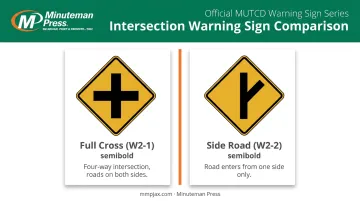
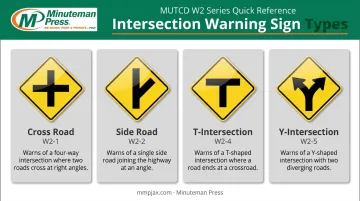
The black plus symbol inside the diamond isn't decorative. It represents a complete four-leg intersection, meaning the crossing road extends on both sides of the main road, not just one. That's what separates W2-1 from other intersection warnings you'll see nearby.
- Full cross (plus sign): four-way intersection with roads on both sides
- Single branch at an angle: a side road, not a full crossroad
MUTCD also requires the symbol to mirror the real layout at that location.
Where Cross Road Signs Are Typically Installed
You'll find W2-1 most often on rural highways, county roads, and low-volume roads without traffic signals. These are exactly the spots where a driver might not expect cross traffic, especially if a hill, curve, or roadside vegetation blocks the view of the intersecting road until the last second.
What To Do When You See a Cross Road Ahead Sign
The moment you spot this sign, start easing off the gas. There's a good chance the crossroad ahead has no signal controlling traffic from either side. Don't assume the road will stay clear just because you're on what feels like the "main" route.
Scan both directions as you approach. Watch for:
- Vehicles approaching from the left or right on the cross street
- Cars stopped or slowing at the intersection, waiting to pull onto your road
- Vehicles that might be preparing to turn across your lane
Here's the part that trips people up: the Cross Road Ahead sign does not grant you the right-of-way. It's a heads-up, not a green light.
Right-of-way depends on the regulatory sign at the intersection itself—usually a stop or yield sign. If nothing controls your approach, don't assume you're clear. Slow down and stay ready to react.
According to FHWA intersection safety data, 7,832 traffic fatalities in 2022 involved an unsignalized intersection (including intersection-related and driveway-access crashes). Uncontrolled crossings deserve real caution.
In areas where sight distance is especially poor, engineers sometimes pair the W2-1 (Cross Road Ahead) sign with an advisory speed plaque mounted directly below it. This plaque recommends a specific speed for navigating the intersection safely, based on an engineering study of that exact location, not a generic guess.
Cross Road Sign vs. Similar Intersection Warning Signs
W2-1 isn't the only intersection warning sign you'll encounter, and mixing them up matters more than you'd think. Each one tells you something different about what's ahead.
| Sign | Configuration | What It Tells You |
|---|---|---|
| Cross Road (W2-1) | Full plus symbol | Four-way intersection, roads on both sides |
| Side Road (W2-2) | One branch, right angle | Road enters from a single side only |
| T-Intersection (W2-4) | Stem ends at a crossbar | Your road terminates ahead; no through path |
| Y-Intersection (W2-5) | Two diverging branches | Road splits into two directions, no perpendicular crossing |
Some drivers treat a "crossroad and double bend" sign as a foreign or state-specific oddity that doesn't exist in standard U.S. signage. That's not quite right.
The MUTCD includes a W1-10 combination series that pairs a curve or turn symbol with the crossroad symbol when an intersection sits in or right next to a bend. Only one cross symbol appears in the combined design, so drivers aren't hit with duplicate warnings.
Where the confusion comes from is naming. "Crossroad and double bend" isn't official MUTCD terminology. It's closer to how the UK's traffic sign manual separately labels "crossroads on a bend" and "series of bends" as distinct diagrams. If you spot a sign described that way, match it against the actual W1-10 design rather than assuming it's non-standard.
Never assume a location has only one hazard. Combination and supplemental signs exist because some intersections stack risks a single symbol can't cover:
- A bend or hill that cuts sight distance
- Limited sight lines at the approach
- Multiple conflict points in one stretch
Read every sign at the location, not just the first one you notice.
MUTCD Compliance and Installation Requirements
Getting a Cross Road Ahead sign right means matching more than shape and color. The MUTCD sets standards for size, reflectivity, and mounting so the sign stays readable day or night, in rain or clear weather.
Size standards (MUTCD Table 2C-1):
- 30" x 30" on conventional single- and multi-lane roads
- 36" x 36" on expressways
- 24" x 24" minimum, up to 48" x 48" for oversized applications
Reflectivity and mounting:
- Black-on-yellow warning signs must meet minimum retroreflectivity values so headlights make them readable at night
- Minimum 5 feet from the sign's bottom edge to the pavement in rural areas
- Minimum 7 feet in business, commercial, or residential zones where pedestrians or cyclists are common
Placement distance isn't a single fixed number that applies everywhere. It's determined through engineering judgment, weighing approach speed, sight distance, and nearby roadway features.
Private property owners often overlook this: you're not legally required to follow MUTCD specs on a private road, but you should anyway. According to FHWA's guidance on private roadways open to public travel, owners who skip MUTCD-style compliance can face increased tort liability if an accident happens near a poorly marked or non-standard intersection.
Matching federal design standards is basic risk management when your roadway is open to public travel.
Getting a Custom Cross Road Ahead Sign Made for Your Property
If you're managing a property with an internal crossroad, you may need this exact sign without going through a municipal traffic department. This applies to:
- Property developers laying out new subdivisions
- HOA boards managing community roads
- Farm and ranch owners with intersecting access roads
- Campuses and industrial sites where internal roads cross
Ordering one privately means finding a shop that understands the specs, not just a printer that can slap a diamond shape on aluminum.
Minuteman Press Jacksonville handles design, fabrication, and printing for durable warning and traffic signage built to MUTCD-style specifications. Sheeting options align with ASTM D4956 and include:
- Engineer Grade
- High Intensity Prismatic
- Diamond Grade
Choose the grade that matches your lighting and roadway conditions so the sign stays readable at night.
You work directly with their team on sizing, sheeting grade, and mounting details before anything is fabricated. Turnaround stays quick, and specs stay accurate.
Ready to get your custom sign started? Contact Minuteman Press Jacksonville at 904-733-5578. You can also request a free estimate online.
Frequently Asked Questions
What is a Cross Road Ahead sign?
A diamond-shaped yellow warning sign with a black cross symbol, officially designated W2-1, alerts drivers to an upcoming four-way intersection. It warns of the crossing but doesn't control right-of-way.
What is a crossroad and double bend sign?
This combination warning pairs the crossroad symbol with a curve or bend warning where an intersection sits close to a series of road bends. In the U.S. MUTCD, it falls under the W1-10 combination series rather than a standalone sign.
What color and shape is a Cross Road Ahead sign?
The sign uses a standard diamond shape with a yellow background, black border, and a black plus-shaped symbol at the center. That color scheme is standardized nationwide for all warning signs.
Does a Cross Road Ahead sign mean I have the right of way?
No. The sign only warns you that an intersection is ahead. Right-of-way is determined by whatever stop or yield sign is posted at the actual intersection, not by W2-1 itself.
Where are Cross Road Ahead signs usually placed?
They're placed in advance of rural, uncontrolled, or low-visibility intersections, giving drivers enough distance to slow down and react before reaching the crossing road.
Can I order a custom Cross Road Ahead sign for my private road or property?
Yes. Sign shops like Minuteman Press Jacksonville design and fabricate custom traffic warning signs to MUTCD-style specifications for private roads, HOAs, farms, and industrial properties.
Visit Us in Jacksonville
Minuteman Press Jacksonville designs and fabricates custom traffic warning signs to MUTCD-style specifications, including retroreflective sheeting options that keep your signs readable day and night. Stop by at 4185 Sunbeam Road, Suite 100, Jacksonville, Florida 32257 or call 904-733-5578 to talk through sizing, sheeting grade, and mounting details for your property's intersection signage.