Yet most campaigns don't get built that way. Businesses pour budget into glossy postcards and clever copy, then grab whatever list is cheapest or fastest. The result? Wasted postage, poor response, and a mailpiece that never reaches anyone who cares.
This guide breaks down the types of mailing lists available, how to choose and clean one, and how a full-service partner like Minuteman Press in Jacksonville can manage list sourcing, printing, and mailing without you juggling three vendors.
Key Takeaways
- Your mailing list drives results as much as your offer: treat it as a strategic asset
- House lists beat purchased data but decay fast—budget for regular address hygiene
- Match response vs. compiled lists to campaign intent, not raw list size
- EDDM removes list cost entirely but drops individual targeting
- A clean, right-sized list beats a large, unverified one every time
What Is a Direct Mail Mailing List?
A mailing list is a structured file of names and physical addresses used to deliver mailpieces to specific recipients. Design, printing, and postage all depend on it: every campaign starts with knowing exactly who receives each piece.
Lists come from two broad sourcing categories:
- House lists: your own customer, inquiry, or sign-up data, built from existing relationships
- Third-party lists: purchased, rented, or compiled by outside data providers who aggregate names
Most lists include core fields like name and mailing address, but targeted campaigns often layer on additional selectors:
- Income range or estimated household value
- Age or age-range brackets
- Homeownership status
- SIC or NAICS codes for business lists (industry and company size)
The more relevant the fields, the sharper your targeting. That only holds if the underlying data is accurate.
The Three Types of Mailing Lists
The list type you choose is one of the strongest drivers of campaign results. These three categories help you match the right data to the right mailing.
House Lists
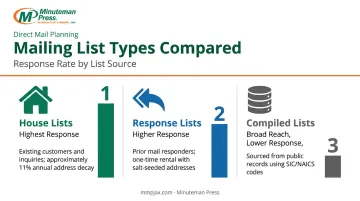
A house list contains people who already have a relationship with your business: customers, past inquiries, and newsletter sign-ups. Because these recipients already know your brand, house lists consistently deliver the highest response rates of any list type.
The catch: people move. According to a Harvard Joint Center for Housing Studies analysis of 2024 Census data, 11.2% of households relocated that year.
That's a meaningful chunk of any house list going stale annually. Running NCOA (National Change of Address) processing before every mailing is basic list hygiene, not an optional extra.
Response Lists
Response lists contain names of people who previously responded to a similar mail offer or made a mail-order purchase. Because these recipients have already shown intent to act on direct mail, response lists typically outperform generic compiled data.
A few practical notes:
- Response lists are usually rented for one-time use through a licensing agreement
- List owners often seed the file with decoy "salt" addresses to catch unauthorized reuse
- Multi-use rentals exist but come with separate licensing terms
Compiled Lists
Compiled lists are built from public records, directories, and registrations rather than mail-response behavior. They offer broad reach, so you can build a list of thousands of records fast, but they generally produce lower response rates since recipients haven't shown prior interest.
Common uses include:
- Reaching businesses by SIC or NAICS industry code
- Filtering households by age, income, or homeownership
- Targeting new movers or specific life-stage segments
Consumer vs. Business Mailing Lists
The audience type shapes which list works and which one wastes money.
| Factor | Consumer (B2C) Lists | Business (B2B) Lists |
|---|---|---|
| Data type | Residential addresses | Company records with contact names/titles |
| Filters | Age, income, homeownership | Industry code, employee count, revenue |
| Best for | Home services, healthcare, retail, real estate | Professional services, B2B outreach, suppliers |
| Decay risk | Address changes | Job title turnover |
Consumer lists work best for campaigns selling directly to households: a roofing company targeting homeowners, a dental practice mailing a neighborhood, or a real estate agent farming a specific zip code.
Business lists fit companies selling to other companies. A commercial cleaning service targeting office managers, for instance, needs a list filtered by NAICS code and employee count, not household income.
Mismatching the two is one of the most common, and costly, direct mail mistakes. Sending a compiled consumer list to a B2B offer (or vice versa) burns budget on recipients who were never going to respond.
How to Choose the Best Mailing List for Your Campaign
There's no universal "best" list. The right choice depends on your campaign goal, your budget, and how precisely you need to target your audience. A grand-opening announcement calls for different data than a renewal offer to lapsed customers.
That said, a few standards separate a usable list from a wasteful one.
NCOA and Move Update Compliance
USPS requires that mailers claiming presorted or automation First-Class Mail rates, or Marketing Mail rates, show their list was updated within 95 days of mailing under the Move Update standard. NCOALink is one approved way to satisfy this; running your list through it before every drop keeps you compliant and cuts return mail.
DPV: Delivery Point Validation
DPV checks whether an address matches a known USPS delivery point. It's a strong quality signal, but there's no single industry-wide "clean list" percentage to chase. Match rates vary by data source and audience type. What matters is that DPV validation happens before printing, not after.
Data Freshness
Consumer address data changes constantly, which is why many list vendors recommend reordering after 60 days even though USPS's compliance window is 95 days. Business data holds up longer on core fields like company name and address, but job titles turn over often. A contact who's a manager today may be a director in six months.
Avoid Over-Filtering
Stacking filter after filter (industry, employee count, job title, geography, recent movers) feels precise, but it can shrink your list past the point of statistical usefulness. A tightly filtered list of 200 names rarely outperforms a slightly broader list of 2,000. A smaller accurate list still beats a large unverified one, but too small stops being meaningful at all.
How to Build or Buy Your Mailing List: Step-by-Step
Here's the practical sequence for getting from "we need a list" to "the mail is dropped."
Define your audience. Nail down geography, demographics, or business filters tied to a specific campaign goal. Don't start buying data before you know who you're trying to reach.
Choose your acquisition method. Use your house list, purchase or rent a third-party list, or skip the list with Every Door Direct Mail (EDDM) saturation mailing to every address on selected carrier routes.
Clean and validate the data. Run CASS certification, NCOA processing, DPV validation, deduplication, and suppression files before anything goes near a printer. Skipping this step is where most wasted postage happens.
Format for presort requirements. Properly sorted and formatted files qualify for USPS automation postage discounts, which can cut your per-piece cost on larger drops.
Work with a full-service partner. Minuteman Press Jacksonville runs list handling, variable data personalization, design, printing, and mailing under one roof. Bring your own list or have one built to spec, with expert consultation and quick turnaround instead of juggling separate vendors.
Test before you scale. Mail a smaller segment first, track response by list source, and use those results to refine targeting before committing to the full drop.
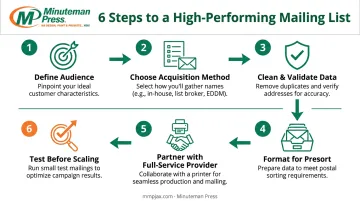
When you're ready to move from plan to drop, Minuteman Press Jacksonville can procure or clean the list, design and print the piece, and prepare the mailing—including EDDM saturation on the routes you choose.
Avoiding Junk Mail Complaints and List Compliance
Complaints and return mail both trace back to the same root cause: a list that wasn't cleaned properly.
- DMAchoice.org lets consumers register to limit unsolicited mail categories. Registration carries a small fee and lasts roughly 10 years.
- Suppression files remove deceased individuals, incarcerated addresses, opted-out consumers, and (for prospecting campaigns) your existing customers. This step protects both budget and sender reputation.
- NCOA processing keeps your list compliant with USPS Move Update rules while cutting returned mail and postage spent on addresses that no longer exist.
None of this is glamorous work, but it's the difference between a list that performs and one that generates complaints.
Frequently Asked Questions
Is there a no junk mail list?
Yes. Consumers can register at DMAchoice.org to opt out of most promotional mail categories. It carries a small processing fee and stays active for roughly 10 years.
What is the best mailing list?
The best list is the one matched to your campaign's goal and budget. A clean, properly targeted list of the right size will consistently outperform a larger, unverified file.
What are the three types of mailing lists?
House lists, response lists, and compiled lists. House lists typically respond best because recipients already know you. Response lists come next because of prior mail-response intent, while compiled lists offer reach but lower response rates.
How much does a mailing list cost for direct mail?
Pricing varies by data source, selection criteria, and volume, so get a current quote for your specific filters. If cost is the main barrier, EDDM removes list cost entirely since no purchased list is needed.
How often should I clean or update my mailing list?
Run NCOA processing before every mailing. Consumer data should be refreshed most often since addresses change faster than most business data, though job titles on B2B lists shift quickly too.
Can I mail to every address in an area without buying a list?
Yes. USPS Every Door Direct Mail (EDDM) lets you saturate entire carrier routes without buying a name list. You select the routes, and the mail goes to every address on them.
Visit Us in Jacksonville
Minuteman Press Jacksonville manages mailing list sourcing, NCOA processing, printing, and mail preparation under one roof, so your direct mail campaign reaches the right addresses without juggling multiple vendors. Call 904-733-5578 or stop by 4185 Sunbeam Road, Suite 100, Jacksonville, Florida 32257 to get started on your next mailing.