Introduction
The house lights are still up. Parents are finding their seats, phones out, program in hand. That little booklet is often the first keepsake a family holds before the curtain even rises, and it sets the tone for everything that follows.
Too many studios treat the program as an afterthought. It gets assembled the week before recital, riddled with typos and mismatched fonts, and ends up crumpled under a car seat instead of tucked into a keepsake box.
Dance educators are encouraged to tell families to save the program because it becomes part of the memory of the night, not just a seating guide (Dance Teacher, 2017).
This guide covers what to include, how to design it well, theme ideas, a realistic planning timeline, and whether print, digital, or both makes sense for your studio.
Key Takeaways
- Balance two jobs in every program: guide the audience and honor everyone involved
- Gather bios, photos, and sponsor info 2–3 months before recital day
- Limit fonts and colors so the layout stays readable under dim theater lighting
- Lock in a theme early to simplify cover design, costumes, and section titles
- Choose professional printing to protect photo quality and keep booklets intact for years
What to Include in Your Dance Recital Program
A good program does two things at once: it helps the audience follow the show, and it recognizes the people who made the show happen. Miss either piece, and the program feels incomplete.
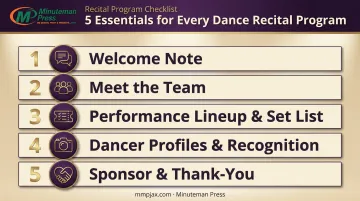
Welcome Note
Open with a short letter from the studio director. Keep it warm, not exhaustive.
- Highlight a season milestone or studio achievement
- Mention a theme or special dedication for this year's show
- Thank families for their support and commitment
- Add a line of studio history (founding year or community highlight) if it fits
- Close with genuine excitement for the performance ahead
Dance educators recommend keeping this note brief and heartfelt rather than turning it into a full speech on paper (Dance Teacher, 2017).
Meet the Team
List directors, choreographers, and instructors by name. A one-line bio or personal note from each adds warmth, especially for families who only see teachers at pickup and drop-off. Note each person’s role, specialty style, or years with the studio when space allows.
Performance Lineup & Set List
This is the functional backbone of the program. For each number, include:
- Dance title
- Music selection and composer/artist
- Choreographer's name
- Class or level performing
- Featured and supporting dancers
- Clear intermission marker
Build this section from your studio's class and running-order grid so names and numbers stay consistent between rehearsal and print.
Dancer Profiles & Recognition
Photos matter here. Headshots or costume shots paired with a short bio give every dancer a moment in print. Graduating seniors deserve more space: a longer tribute, a "then and now" photo pairing, or a note from their favorite instructor.
One practical note: source higher-quality photos rather than relying only on phone camera shots pulled from a group chat. Low-resolution images that look fine on a screen often turn blurry once printed at full page size.
Sponsor & Thank-You Section
List sponsors with their logos, and thank volunteers, backstage crew, and stage parents by name. Clear appreciation builds goodwill that makes local businesses more likely to sponsor again next season.
Design Tips for a Professional, Eye-Catching Program
Great content in a cluttered layout still reads as unprofessional, especially when someone is trying to read it in a dim theater between numbers.
Type, Layout & Color
Keep the booklet easy to scan in low light:
- Stick to 2–3 legible fonts from cover to back page
- Set a clear size gap between section headers, act titles, and body text
- Leave generous white space so pages don’t feel cramped
- Limit the palette to two or three colors tied to studio branding or the recital theme
Body copy with strong contrast and open spacing reads more comfortably than dense pages (AIGA Eye on Design, 2017). A tight color system looks polished; a rainbow of accents on every page does not.
Photos & Personality Touches
Use high-resolution action shots and candid rehearsal photos where you can. On the cover, pair the studio logo with one strong image rather than a busy collage.
A short dance quote at a section break adds personality without clutter. One or two per booklet is plenty—more starts to feel like filler.
Final Polish
Names get misspelled more often than anything else in a program. Before you approve the file:
- Run more than one proofreading pass
- Have a second person check dancer names, class titles, and sponsor listings
- Review a physical sample copy before the full print run
Colors, spacing, and photo clarity often look different on paper than they do on screen.
Choosing a Theme for Your Dance Recital Program
A theme gives the whole program a sense of cohesion, from the cover art down to the section titles.
Popular categories include:
| Theme Category | Example Ideas |
|---|---|
| Storybook/Fairy Tale | Nursery Rhymes, Storybook Adventures |
| Broadway/Movie Tribute | On Broadway, Hollywood Red Carpet |
| Decades | Dancing Through the Decades, 80s Rewind |
| Around the World | Around the World, Oh! The Places You'll Go |
| Seasonal | Beach Party, Holiday Showcase |
These categories show up often on recital theme lists because they work across age groups and class levels (Dance Informa, 2019).
Once you pick a theme, let it guide the cover design, color palette, and section titles throughout the booklet. Lock it in early. Choose the theme in January instead of April so costume orders, photography, and program layout can line up—without a last-minute scramble.
When to Start: A Dance Recital Program Planning Timeline
An 8-to-20-page program, complete with photos, bios, and a finalized set list, takes real lead time to assemble. Waiting until two weeks out almost guarantees typos and missing content.
- 2-3 months out: Draft the program outline, lock in the theme, and start collecting dancer photos and bios.
- 6-8 weeks out: Set deadlines for sponsor ads, senior tributes, and staff bios.
- 4 weeks out: Get the finalized set list and running order from instructors.
- 2 weeks out: Freeze the show order unless a genuine production issue forces a change.
- Final 2 weeks: Dedicate this window strictly to proofing and printing.
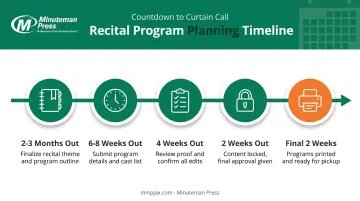
That last stretch matters most. Rushed proofing is where typos slip through, and printers need enough lead time to produce a clean, bound final product.
Print, Digital, or Both? Choosing the Right Format
Print and digital each solve a different problem on recital night—and many studios use both.
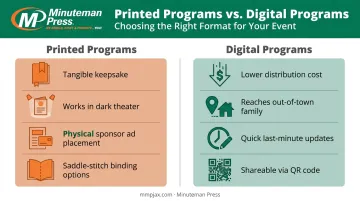
Printed programs:
- Feel tangible and become a real keepsake
- Work reliably in a dark theater when phones need to stay off
- Give sponsors a physical ad placement they can point to
Digital programs:
- Cost less to distribute
- Reach out-of-town grandparents and family who couldn't attend
- Update quickly when cast lists or cues change last-minute
A hybrid approach often works best: printed copies at the venue, plus a shareable digital or flipbook file for anyone following from home. Some studios print a QR code inside the program that links straight to that digital version.
On the print side, a few practical decisions shape cost:
- Binding style: Saddle-stitch (stapled at the fold) is standard for recital booklets and lays flat when opened
- Trim size: 5.5" x 8.5" keeps a compact booklet affordable; 8.5" x 11" leaves more room for photos and sponsor ads
- Paper weight: Heavier cover stock holds up better to repeated handling than standard text-weight paper
Why Professional Printing Makes the Difference
DIY photocopying tends to fall apart under scrutiny. Photos come out grainy, staples pull loose, and the paper feels flimsy by the time it's handed out at the second show of the weekend. None of that makes for a keepsake worth saving.
A local full-service print partner delivers a different result. Minuteman Press in Jacksonville offers:
- Design help that turns your theme and content into a clean, print-ready layout
- Binding matched to page count and feel, including saddle-stitch, perfect binding, and spiral
- Proofing before the full run—digital PDF and printed paper proofs—so errors get caught early
- Quick turnaround built for the tight deadlines recital season creates
Recital season gets busy fast, for studios and print shops alike. Reaching out early for a quote gives your program room to be proofed properly instead of rushed at the last minute. You can request an estimate at mmpjax.com's service center or call 904-733-5578 to talk through page count, binding, and timeline with their team.
Frequently Asked Questions
What is a recital program?
A recital program is a printed or digital booklet that lists performances, dancers, and credits. It doubles as a keepsake and a thank-you for sponsors and volunteers who supported the show.
What are some good dance recital themes?
Popular options include storybook/fairy tale, Broadway or movie tributes, decades, around-the-world, and seasonal themes. Whichever you choose should tie directly into the cover design and color palette.
How many pages should a dance recital program be?
Most studio programs run 8 to 20 pages, depending on the number of routines, how many dancer bios are included, and whether sponsor pages are added.
What should be included in a dance recital program?
At minimum: a welcome note, team credits, the performance lineup, dancer profiles, and a sponsor or thank-you section. That mix gives families the show order and credits the people behind it.
How far in advance should I start planning my program?
Start outlining content and gathering photos 2-3 months before recital day. Reserve the final two weeks strictly for proofing and printing, with no changes to show order unless truly necessary.
Should I offer a digital program in addition to print?
A hybrid approach works well: a printed keepsake for the venue, plus a shareable digital version for out-of-town families. It can also lower printing costs on larger programs.
Visit Us in Jacksonville
Minuteman Press Jacksonville prints dance recital programs with design help, binding matched to page count, and proofing before the full run - so your program looks as polished as the performance it accompanies. Call 904-733-5578 or visit 4185 Sunbeam Road, Suite 100, Jacksonville, Florida 32257 early in your planning timeline to give your program the lead time it deserves.