Custom banners remain one of the most cost-effective tools nonprofits have for building visibility, credibility, and donor trust. They work at galas, walks, school partnerships, and outreach booths alike. This guide covers design best practices, material choices, and budget-friendly printing strategies built specifically for nonprofit organizations.
Key Takeaways
- Strategic placement near entrances and registration desks maximizes banner visibility without extra spending
- Choose fabric for polished indoor events; use vinyl or mesh vinyl for outdoor weather and wind
- Reusable, date-free designs stretch limited nonprofit budgets across multiple events
- QR codes and clear calls-to-action turn banner views into donations and sign-ups
Why Custom Banners Matter for Nonprofit Visibility and Impact
Visibility at events creates engagement opportunities with donors, volunteers, and community members before a single conversation happens.
Bold colors and clear fonts help your banner stand out from across a crowded room. Placement matters just as much as design. High-traffic spots deliver the biggest return without costing a dime extra:
- Near entrances, where every attendee passes
- At registration desks, where people linger while checking in
- Close to refreshment tables, where foot traffic naturally slows down
Physical signage carries real weight in event marketing. A 2024 CEIR report highlighted by Trade Show Executive found that on-site banners and signage rated among the most effective tools for brand exposure. Visible physical identifiers scored especially well for promoting something new.
That's exactly the position most nonprofits are in at any given event: introducing a mission to people who haven't heard it yet.
A banner works as a visual extension of your organization's story. Say a literacy nonprofit hangs a banner reading "1 in 4 kids in this city can't read at grade level. Here's how we're changing that." That single line does more to spark curiosity and pull foot traffic toward the booth than a table full of brochures ever could.
Designing Nonprofit Banners That Communicate Your Mission
Strong banner design puts a few critical details front and center. Cut everything else so your mission lands in a glance.
Keep Branding Consistent Across Materials
Your banner's colors, fonts, logo, and tagline should mirror what's on your brochures, website, and social channels. Consistency builds recognition, and recognition builds trust over time.
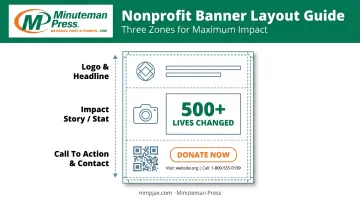
Divide the Banner Into Three Visual Zones
Divide your banner into three visual zones:
- Top — logo and headline
- Middle — impact story or visual (a photo, a stat, a short narrative)
- Bottom — call-to-action and contact details
This structure lets someone absorb your message in a three-second glance, which is often all you get.
Keep Messaging Short and Emotionally Resonant
Skip the full mission statement. One punchy phrase beats three sentences of context every time. Add a QR code linking to a donation page or volunteer sign-up form. Cvent's event technology guide notes that QR codes are now standard practice for quick attendee action at events.
Prioritize High-Quality, Authentic Visuals
Real photos of the people you serve or the work you've completed build authenticity that stock imagery can't fake. A photo of last year's volunteer crew painting a school fence tells a better story than a smiling stock photo ever will.
Choose the Right Size for the Setting
Retractable banners commonly run in the 33 to 33.5-inch width range, with heights around 79 to 81 inches depending on the manufacturer's stand. Tabletop banners work better for smaller booths or registration tables where floor space is tight.
Design for Accessibility
Use large, legible fonts and high-contrast color combinations, such as dark text on a light background. The Web Content Accessibility Guidelines recommend a 4.5:1 contrast ratio for standard text, a useful benchmark even though it's technically written for web content. Readable design helps every attendee, including those with visual impairments.
Choosing the Right Material for Nonprofit Banners
Material choice affects how your banner looks, how long it lasts, and what it costs. Matching material to setting matters more than most people realize.
| Material | Best For | Why |
|---|---|---|
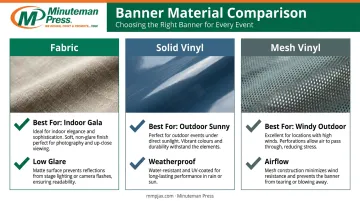
| Fabric | Indoor galas, expos | Polished look, minimal glare under lighting |
| Solid vinyl | Outdoor events | Durable against rain and sun exposure |
| Mesh vinyl | Windy outdoor spots | Allows airflow while staying visible |
Fabric banners work well for indoor events because they reflect less light than vinyl, giving them a softer, more professional appearance under gallery or ballroom lighting.
Vinyl banners are the workhorse choice for outdoor use. They hold up against weather, though a solid vinyl surface can act like a sail in strong wind.
Mesh vinyl solves that wind problem. The perforated surface lets air pass through, reducing strain on grommets and stands, while still displaying your message clearly.
One more tip that saves real money: skip the exact date on your banner design. An evergreen banner reading "Support Our Mission" instead of "Support Our Mission — Spring Gala 2025" can be reused year after year, stretching a single print budget across multiple events.
Best Occasions to Use Custom Banners for Nonprofit Campaigns
Banners earn their keep at nearly any event where your organization needs to be seen and remembered. Strong fits include:
- Fundraising galas and donor receptions
- Awareness walks, runs, and 5Ks
- Volunteer recruitment drives
- Community outreach booths and tabling events
Schools, churches, and community partner events are equally strong opportunities. A banner at a church fellowship hall or a school open house puts your mission in front of an audience that's already inclined to care.
Seasonal campaigns gain the most from a clear banner. A holiday donation drive or back-to-school supply push can put the deadline and the ask in plain sight—so people act now instead of later.
Budget-Friendly Printing Tips for Nonprofit Organizations
Nonprofit budgets are tight by nature, but smart planning can stretch every printing dollar further.
- Order ahead for multiple events. Plan your calendar and print in bulk—size, material, and quantity are documented cost variables that lower per-unit price.
- Work with a full-service local print partner. A shop that offers design consultation alongside printing helps you avoid costly redesigns and reprints.
- Choose reusable, evergreen designs. As covered above, skipping event-specific dates means one banner can serve several campaigns.
Minuteman Press in Jacksonville helps nonprofits plan banner projects this way. The team produces custom-size banners, from one-color to full-color, finished with grommets and ties for easy hanging. They quote each job per project, so you can review size, material, and quantity against your real budget instead of a generic price list.
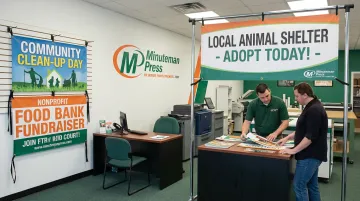
Their Sunbeam Road location makes drop-in consultations straightforward for Jacksonville-area organizations prepping the next event.
Common Mistakes to Avoid When Designing Nonprofit Banners
Even a well-intentioned banner can fall flat if it makes one of these common errors.
- Overcrowding with text. A banner isn't a brochure. Too many details means nobody reads it from a distance.
- Poor color contrast. Light gray on white may look fine on screen, but it disappears in outdoor sunlight. Use strong, high-contrast pairings.
- Missing call-to-action. This mistake costs the most. Without a website, QR code, or contact info, viewers notice the banner but never convert. Always give a next step.
Frequently Asked Questions
What size banner is best for a nonprofit event?
Retractable banners about 33–33.5 inches wide by 79–81 inches tall work well for booths and check-in areas. Smaller tabletop banners suit registration desks or tight floor space.
Should I choose vinyl or fabric for my nonprofit banner?
Fabric suits indoor events like galas, giving a polished look with less glare under lighting. Vinyl holds up better outdoors against rain, wind, and sun exposure.
How much do custom nonprofit banners typically cost?
Costs vary based on size, material, and quantity ordered. Bulk ordering ahead of multiple events or choosing a reusable, date-free design helps lower overall expenses.
How far in advance should a nonprofit order banners for an event?
Order several weeks ahead. That window leaves room for design revisions, proof approval, and production without rush fees.
What information should be included on a nonprofit banner?
Include your organization's name and logo, a short mission-driven message, and a clear call-to-action with contact or website details. A QR code linking to a donation page is a strong addition.
Can nonprofits get discounts on custom banner printing?
Many print shops offer volume or custom pricing on request. Minuteman Press in Jacksonville can quote by size, material, and quantity for your organization's needs.
Visit Us in Jacksonville
Minuteman Press Jacksonville helps nonprofits plan and print custom banners - from full-color fabric banners for indoor galas to durable vinyl for outdoor walks and community events. Call 904-733-5578 or stop by 4185 Sunbeam Road, Suite 100, Jacksonville, Florida 32257 to talk through your banner project and get a quote matched to your organization's budget.